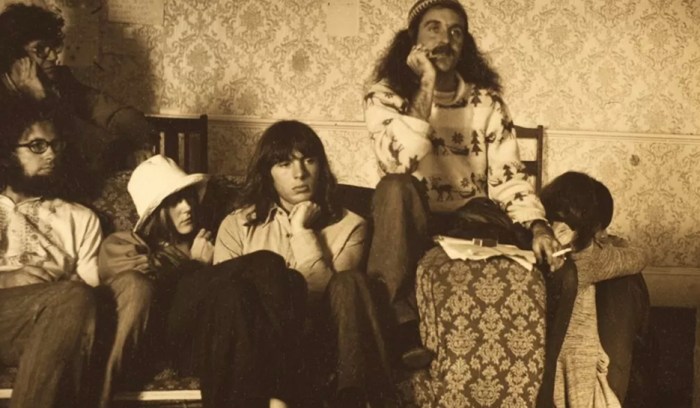
A scene from Senses of Cinema.


Senses of Cinema explores the history of the co-op film movements of Sydney and Melbourne.
This incredibly insightful and highly important documentary comes from two of the major figures in Australian documentary who were intimately involved in the filmmaking groundswell that first emerged in the 1960s, John Hughes and Tom Zubrycki.
Featuring the like of Philip Noyce, Gillian Armstrong, Albie Thoms, Stephen Wallace, Martha Ansara, Essie Coffey and many others, Senses of Cinema is the story of the rise of alternative forms of filmmaking, and their fall at the hands of government agencies.
It is a story of a road not taken, but of a moment full of possibility when fresh voices and new ways of seeing struggled to establish themselves in Australian cinema.

Tom Zubrycki.
Tom Zubrycki was born in London in 1946, though his family migrated to Sydney in 1955. After studying sociology, he became involved with the Sydney Filmmakers’ Co-op in the 1970s. He has taught documentary filmmaking at UTS and the Australian Film Television and Radio School. He has directed over 15 features including Kemira – Diary of a Strike(1984), The Diplomat (2000), Gulpilil – One Red Blood (2002), and Molly and Mubarak (2003). He has produced many other films and has won numerous awards including four AFI/AACTA Awards.

John Hughes.
John Hughes is a Melbourne-based filmmaker who was born in 1948. He has taught at several Victorian universities as well as being a commissioning editor for SBS Independent. His documentary films often centre on Australian film history and include Film-Work (1981), After Mabo (1997), The Archive Project (2006), and Indonesia Calling (2009).
This interview is a brief look into the making of the documentary Senses of Cinema, but you can find a far more detailed history of this project here.
Senses of Cinema will have its final screening at the Adelaide Film Festival on Sunday, October 30 at 11am. Details here.

Faces, by Sue Ford (1976). Image: Common State.
“Collections from the co-ops did go to the National Film and Sound Archive, but it has taken decades for a priority on that body of work to be recognised. We hope that Senses of Cinema will be helpful in drawing attention to the importance and value of that body of material.
Interview by Matthew Eeles
I enjoyed this film a lot. I was glued to it because I want to know as much as possible about the Australian film history. There is a frustration with it in that I want to see every film that’s featured in it, and I want to know a lot more about the filmmakers featured in it, but Senses of Cinema doesn’t always give us that information.
John Hughes: I think what you have highlighted is the necessity for a serious, comprehensive historical project on the body of work of those organisations. The films that are collected in the catalogues of the cohorts are not comprehensively aggregated in any coherent collection, which to some extent, I suppose, is the definition of the independent film. As opposed to, for example, films that are sponsored by government which are collected and documented thoroughly in official collections. There is a Senses of Cinema article (see above) about co-ops which is available and is footnoted. That article does give some direction to people like yourself who are more interested in more detail. But I agree with you completely in that there is an absence of comprehensive detail around that period.
Tom Zubrycki: John’s article in the journal Sense of Cinema about the co-ops is quite an extensive piece of work which goes into a lot more detail about the way the co-ops ran. You are right though in that there is no complete list, I suppose, or collection of films that were all made independently. It’s extremely hard to put together a comprehensive list. What would be good at some stage would be to create a website where that would be possible. It would need to be funded.
I can only image the work that has gone into collecting some of the footage shown throughout Senses of Cinema.
Tom Zubrycki: Well, because we’ve been involved in the co-ops respectively in Sydney, and John and Melbourne, we kind of knew the filmmakers and we had seen and lot the films ourselves. We quickly compiled a short list of films and directors that we wanted to feature in the film. Not every director made the cut, but we just put together a selection of people who we felt represented the various movements and issues that we wanted represented in the film. It’s partly around issues and filmmaking styles that were represented through all the films at the co-op. We started with Albie Thoms and end end up with Gilian Leahy.
John Hughes: The Sydney filmmakers’ co-op was the co-op that had the most sustained life from the mid sixties through to the mid eighties, and runs through three quite distinct periods. The Sydney co-op was just about to emerge into full when it closed down. So we were really looking for people with particular landmark works that signified the political and aesthetic development that was taking place over those particular periods. So that’s how we worked on trying to distill from the hundreds of films that we cited in the co-op catalogues. Co-op catalogues are the main document that aggregates the body of work that was made during that period.
The film features prominent Australian filmmakers of that time like Phillip Noyce and Gillian Armstrong, but obviously there are a lot of people who couldn’t feature in the film for one reason or another. Is there anyone in particular who you would have loved to have featured in the Senses of Cinema?
Tom Zubrycki: So many. Any number of them.
John Hughes: I would like to have seen much more of Tom Zubrycki in the film. [Laughs].
Tom Zubrycki: Likewise, John. Neither one of us actually appear on camera, but our films are represented. We’re a bit shy. [Laughs].
John Hughes: There was a project that I made for the National Film and Sound Archive of Australia. It was a little showcase thing concerning their archives, and it featured a wonderful work of Tom’s called Pig Street Fiasco. I would’ve loved to have seen that in Senses of Cinema, but that’s one of very many startling moments that there just isn’t time for. It would’ve been great to be able to include some of the early work of Jan Chapman, for example. Jan Chapman is another person who is extremely well-known and prominent and highly regarded in Australian film and culture over the last 30 years. Jan was one of the people who was there from day one at the Sydney Filmmakers Co-op and indeed made the curtains for the cinema. There’s a lot of examples of that kind where it would’ve been wonderful to include one person or another. It would’ve been terrific to include more of David Bradbury’s films. It would’ve been great to include the films of the wonderful animations and cartoons of Bruce Petty. There’s a long list of those examples.
You two are obviously very well educated on this subject, but during your research for the film, did you learn anything about this particular era of Australian filmmaking that surprised you?
Tom Zubrycki: Basically it reminded me just how proud we all were of being independent, but also how the film culture at that time had these radical roots. A lot of them were radical in terms of form, but also content. It was the time when liberation movements were for not only women, but also the LGBTQI community. Both co-ops, I think as John suggested, were during a period when women really stepped up to the fore. What it reminded me of was how few opportunities women had at that time to work across the broadcast and filmmaking spectrum. It just reminded me just how many things have changed from that time. Not everything has changed unfortunately as women are still knocking on doors asking to be given the opportunity to make films and television documentaries right across the board. In many ways, the kind of issues that were around in the eighties are still around now, but maybe impacting on different sectors of society.
Do groups like the Sydney and Melbourne co-ops still exist today?
John Hughes: There are in both Melbourne and Sydney certainly. There’s a fantastic group in Sydney called OZDOCS which in many ways carries on the spirit of the co-op, but with a particular focus on documentary production and culture. That’s a very strong organisation that’s been going for quite a long time. But in some ways, the continuation of the co-ops is also apparent in the Australian Director’s Guild which in some ways came out of the activists in the co-op. In Melbourne there’s a group run by Bill Mousoulis and Chris Luscri that run regular screenings at the Thornbury Picture House. That group has very much the feeling of a cinematic co-op that’s dedicated to unusual Australian work. They’re always full houses. There’s also a lot of smaller groups that are more specialised who build around social networks. There’s a lot of groups today fascinated by the non-digital formats like 16 millimetre film who want to see the projector in the room. So yes, there are lots of actions going on, but the big difference really is the fragmentation of distribution and access that has taken place over recent decades which has produced an entirely different kind of practice of the distribution of moving image work through society more broadly. A lot of the kind of work that we associate with the co-ops you can now find in galleries or scholarly communities. Whereas at that time there was an absolute necessity for filmmakers to come together and form organisations that could represent a different way of going about sharing the moving image.
Is enough being done on a government level to restore and archive these films. I know the NFSA does a terrific job, but could more be done?
Tom Zubrycki: Absolutely more can be done. We’re very hopeful that the government will supply funding to make that possible. There is actually a big push to try and get the fragile 16 millimetre film protected and digitised properly. I’ve been told there is a big piece of machinery at the National Film and Sound Archive that’s being installed at the moment which will make that process happen quicker and more effective.
John Hughes: Interestingly, the body of work that is most threatened presently is the analog work and the early video work. Film is a much, much more stable archival base than the analog materials, both audio and video. So in some ways, there’s been a terrific program over recent years to try and dedicate energy and resources to preserving the analog and so-called magnetic media, which Tom was talking about. That really needs attention. The National Film and Sound Archive is going through and restoring key works and they had turned their attention to independent documentary as well as independent drama whereas for many years the focus seemed to be entirely concerned with just with the historical dramas, like the very many versions of Ned Kelly and so on. Collections from the co-ops did go to the National Film and Sound Archive, but it has taken decades for a priority on that body of work to be recognised. We hope that Senses of Cinema will be helpful in drawing attention to the importance and value of that body of material.
Senses of Cinema will have its final screening at the Adelaide Film Festival on Sunday, October 30 at 11am. Details here.


 Cinema Australia