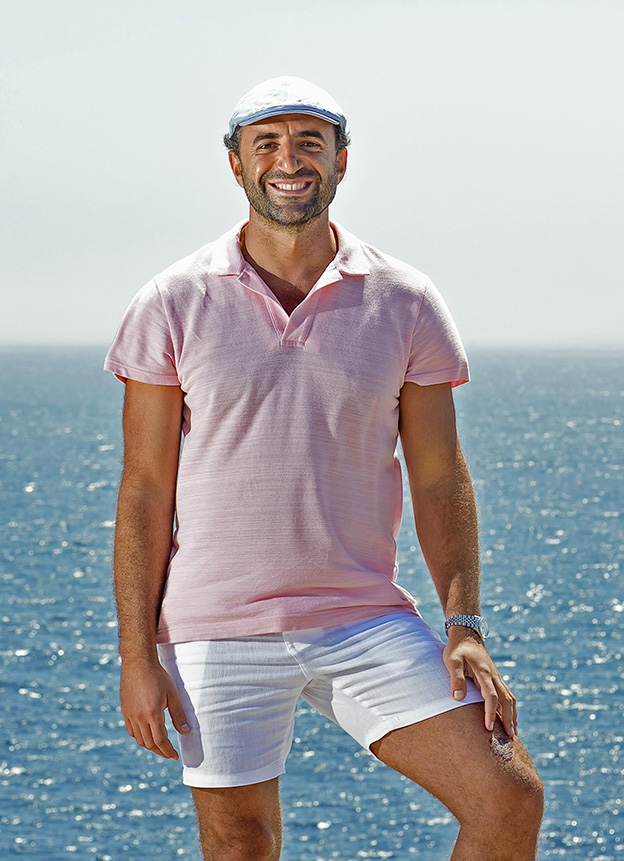
Nadi Sha at Maroubra beach.


18-year-old Jay has had enough of life. 28-year-old Liz can’t get enough of it. And as Jay (Jordan Dulieu) stands on a cliff top contemplating putting an end to the meaningless fog of his existence, Liz (Freyja Benjamin) lands in town on the latest leg of her endless adventures backpacking the globe.
After a sliding doors moment brings this unlikely pair together, they form a deep and immediate bond – much to the chagrin of Jay’s privileged but jaded socialite parents (Gigi Edgley and Martin Crewes).
Unfortunately, Liz’s laissez-faire life style is brought to an abrupt halt by a life-threatening mystery illness and, as Jay becomes more and more entwined in her plight, all four are forced to come to terms with their worldviews in this harrowing, provocative, yet ultimately uplifting saga.
“In the current entertainment landscape, where abundant and disposable content provided by deep-pocketed studios is readily available in various formats on countless platforms, why would someone set out to make a feature film?” says Everything in Between director Nadi Sha.
“I cannot speak for fellow filmmakers, but in the case of Everything in Between, it was because it was more painful to keep the story in my heart than it was to let it out.”
In this interview, Sha fills us in one the making of his new film.
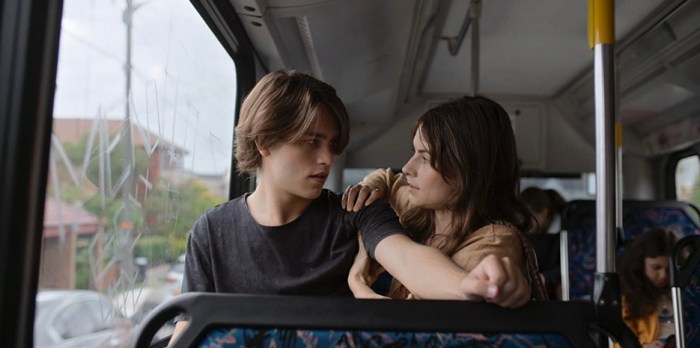
Freyja Benjamin and Jordan Dulieu in Everything in Between.
“I don’t want to say filmmaking for me happened by accident, but it’s one of those things where it came to me rather than me chasing after it.”
Interview by Matthew Eeles
Everything in Between is your first feature film following the short film, KinShip. What’s your filmmaking background?
I started writing stories 13 years ago. Before that, I had no experience at all. I studied civil engineering. I have a background in business and property development. So filmmaking is something completely new to me. I guess you could say I had another life. I just had a curiosity. I don’t want to say filmmaking for me happened by accident, but it’s one of those things where it came to me rather than me chasing after it. I tried to run away from it for a little while because I knew how difficult it would be. It caught up to me and I kept trying to do other things, and then I just eventually gave into it in 2016. I said to myself, “I’m a filmmaker. I can’t deny this.” And I just started writing. From 2010 until the end of 2016, I had only written one script so I really stepped on the pedal at the beginning of 2017 and I started writing more. I’ve written eight or nine scripts now. I’ve made one short film and now I’ve made Everything In Between. I’m currently in the process of green lighting my next feature.
You say it happened by accident. You must have had a general interest in filmmaking though.
I’m more interested in storytelling rather than actual filmmaking. I like the idea of moving the heart. Obviously filmmaking is just one medium of storytelling. I could write poetry, I could sing music, but film is just one of many mediums. To be honest, for me, it’s more about creating emotion. If I could write a poem to replace all my scripts, I’m happy to do that if it creates more of an impact. So it’s not so much about the moving pictures, it’s about creating emotion.
You co-wrote Everything In Between with Grant Osborn. How did that collaboration come about?
Grant is so much more than just a co-writer. He’s like my mentor as well. He’s a lot more experienced in film. I came across Grant earlier in 2016. He reviewed a script of mine that I had been writing for seven years. It’s a period piece… a true story. It’s set in New York and much more complicated. It’s based on love letters and it’s really, really complex. He gave the script a fascinating review. He wrote ten pages of notes on this script and I just fell in love with this feedback that he gave me. By that stage, I had talked to a director named Kay Pollak who directed As It Is In Heaven, a Swedish film that was nominated for an Oscar for Best Foreign Language Film in 2005. It had the longest running theatrical release in Australia after Titanic. It ran for longer than a year. So Kay was interested in the script that I wrote, but he said, “Look, you need to team up with someone. You need a consultant.” Kay, to me, is like Yoda. He’s one of those people that when they say something, you sort of feel like it comes through from the heavens. Kay was telling me this just as I received my review from Grant. I was really moved by Grant’s view, so I figured it’s a sign. So Grant came on as a script consultant for this other ginormous epic story that I’ve been trying to write for seven years. We just got on really well and he became a co-writer on that one. We have a beautiful synergy. We write so well together. We ended up writing two other scripts. And then the script got into Sundance as one of twenty nine in the world, and the only Australian one to get in. This was December 2019 just before the world got turned upside down. Grant and I had written three films, each one bigger than the next, and I had written another five or six other scripts at that stage. We looked at all of them and I said, “Let’s look at this one.” The film was called Beings at the time but eventually became Everything In Between.
Was Grant on set with you through the Everything in Between shoot?
He was most days. He was also producing and running a really tight ship. We didn’t have a location manager, nor a line producer, nor a production coordinator. Our production manager was quite amazing, but it’s her first time so Grant was also very hands on with managing the production. He was on set most days and popped his head in at least once a day. It’s all a big blur now. [Laughs]. He was mainly making sure we were able to shoot the next day.
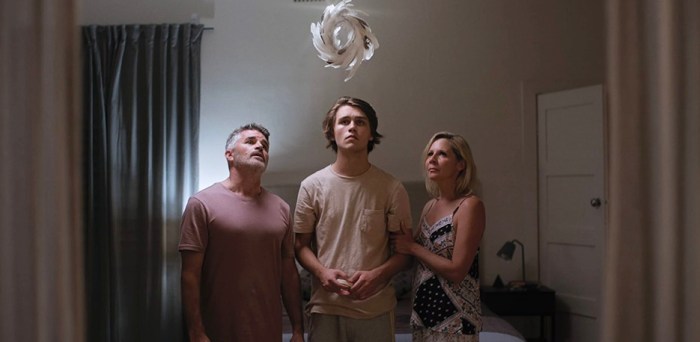
Martin Crewes, Jordan Dulieu and Gigi Edgley in Everything in Between.
They say to write what you know. Did you draw on any personal experiences for Everything in Between?
Energy-wise, yes. I was probably a lot older than this guy when I had my existential crisis. This character, Jason, is having a spiritual crisis or existential crisis, whatever you want to call it. He’s struggling to understand why he’s alive and grazing this earth. Other than that, not much of my own story is tied in with Jason’s. It’s quite different. I had very different parents. I guess I could say I drew on some of my own elements when it comes to Jason’s view of the world and his constant questioning of his existence. Other than that, not much. It’s not so much a personal story, but it’s a universal one. I wanted Everything in Between to be a story people could connect with. So the honest answer is that very little was based on me. It was inspired by a lot of realities, and not just the character of Jason, but the locations and the cast. The film is shot in Sydney and a lot of the actors in the film are actually friends of mine. A lot of the film was shot at my office. There was a scene shot in the building where my home is. So the journey of making the film was a lot more personal to me than the actual story was.
You’ve said that you collaborated with medical experts to make this psychological world as real as possible. I’ve had friends in similar situations, like I’m sure most of us have, and it all seemed very authentic to me. What was the extent of that collaboration?
It was huge. There are two key people who I collaborated with on this film. One of them was Dr. Siham Yahya who is credited as a co-producer on the film, and she also acts in the film as Dr. Freeda Yussuf, a registrar psychiatrist. Ironically, she also introduced me to Grant. In real life Dr. Siham Yahya is a clinical psychologist with many years of experience. I have known her for a long, long time and I drew on her expertise. The other collaborator was Dr. Cameron Armstrong. He’s in the credits as a subject matter expert, but he also played the role of the waiter, James. When I first wrote the original script, Cameron and I were workshopping scenes together with the psychiatrist. He was just incredible. His official title now is Dr Cameron Armstrong (FRANZCP) – consultant psychiatrist and clinical lead for Outreach Mental Health in Western Sydney. He’s a true wealth of knowledge. He worked at a video store for a good number of years so he gets film, he gets storytelling. In the film we have two psychiatry sessions, and they take place within like three minutes. It takes some real talent to be able to explain what we wanted to say in only a few minutes, which in real life would take a one hour therapy session.
Authenticity must have been a big factor to you.
It was. And I praise Grant for that actually. He’s old school. Back in the day they spect much more time developing their stories and getting things right. These days we rush our stories. I’m not saying stories were more authentic back then, but the classics certainly feel like they’re more authentic.
The head psychiatrist in the film is quite dismissive of Jay. I’d love to know more about that particular character and why he was so dismissive.
The consultant psychiatrist. He’s a busy guy. He has so much of this stuff coming through the hospital, so we set him up to have a different perspective than his colleague who is much more sympathetic to Jason. There’s a bit of a backstory between them, which of course was just for the actors, but it comes through on screen that there may have been a relationship breakdown between the two. She may have turned down his advances and we wanted to show the power trip that some of these guys have. Sometimes the patient becomes the victim of another person’s ego. Grant and I wanted to give much more purpose to that character’s scenes. I wish we could have gone further with it, but obviously we were working on a shoestring budget. The one takeaway of that scene is that this poor kid is let down by his family, and he’s also let down by the system. Jason shouldn’t have been sent home, and he got sent home. The second time, he should have been sent home, but they kept him in.
One thing I took away from my viewing is that the film doesn’t seem to be pushing an agenda onto the audience. Was that something you and Grant were aware of while writing the film?
A hundred percent, absolutely. The film not only doesn’t push an agenda, we’re not claiming to solve anything. Even releasing the film during mental health month wasn’t intentional. It’s serendipitous. The only thing we’re happy about is that we’re destigmatising mental health by making a film about the topic. We’re proud to say, “You know what? Let’s talk about someone who doesn’t wanna live.” We’re not solving it. This isn’t a fairy tale, and the film certainly doesn’t have a fairytale ending.
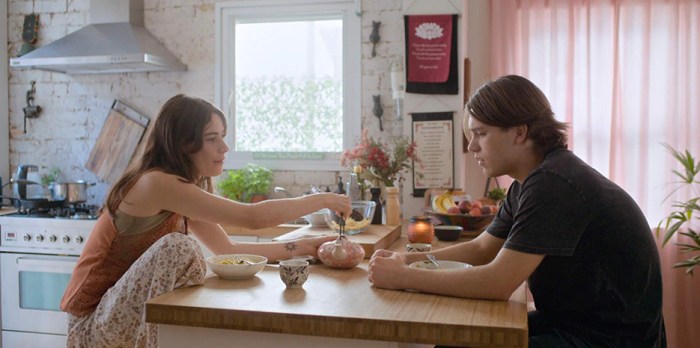
Freyja Benjamin and Jordan Dulieu in Everything in Between.
Jordan Dulieu, Freyja Benjamin, Martin Crews and Gigi Edgely are all terrific. Can you tell us about casting the film?
We’re very fortunate to have an incredible casting director, Allison Meadows. She’s one of the more accomplished casting directors in the country, I believe. We started with Jason, and we knew that we wanted to unearth a new talent and potentially discover the next big thing. They ended up getting over four hundred applications. Eventually Jordan Dulieu was cast and he was just magical. I mean, he was incredible. Grant calls him the James Dean of Australia, not in longevity of course, but because he’s such a beautiful guy. He’s captivating. With the Elizabeth Myers character, I intentionally gravitated towards someone who fits into the skin of the character, and Freyja Benjamin was the perfect fit. And to justify my decision, throughout the film you see photographs from throughout Elizabeth’s life. Well they’re actually Freya’s own photos from her actually life.
And the parents, wow. What perfect casting. Do you remember Gigi from her Farscape days?
I never got into Farscape, but I’m a big fan of Gigi’s. She was a standout in Stingers and Last Train to Freo.
Oh, brilliant. She just blew us away. She was the first tape that came through, and honestly, we were all just like, “Okay, we’ve got it.” As soon as we saw her tape we were not having any conversation with anyone. She was it. She’s got it. Now with the dad other filmmakers have told me that the men are harder to cast. It’s not as simple as the women. I was told that by the experts and I’m just quoting them. But my God, when Martin’s tape came in we knew we had our man. During lockdown he came to my office to meet me and we connected straight away.
Did the cast get to spend much time together before the shoot?
I over rehearsed, if you want to call it that. I really wanted to over prepare. That helps everyone psychologically to be ready. We spent quite a bit of time together. Gigi was in LA at the time, so she only came in a couple of weeks before we shot, and she did quarantine. We had around three or four days to quickly rehearse. We did quite a bit of work together over Zoom.
So now that you have your first feature film under your belt, what would you say has been the biggest lesson you learnt while working on Everything in Between that you will take into your next film?
I would lock in my heads of department much earlier. Even with our costume designer for example. In pre-production I was signing off on every garment. Closer to the shoot and during, I was too overloaded to properly assess every piece. I would’ve loved an earlier start with the heads of department.
Everything in Between is in cinemas now.


 Cinema Australia