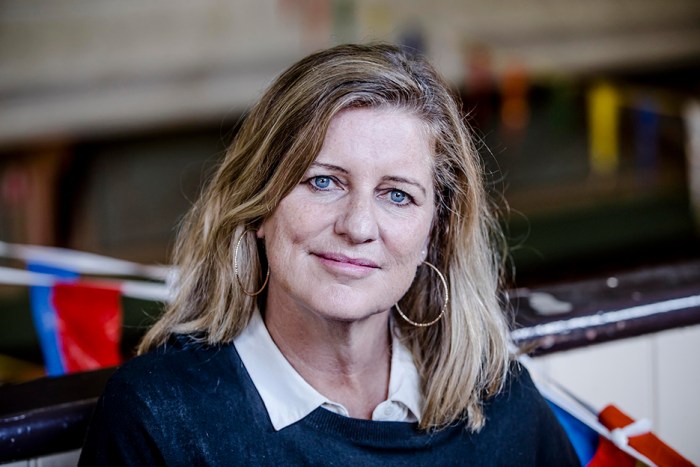
Sue Thomson


Narrated by Margot Robbie and sharing the lives of an eclectic group of women throughout Australia, Sue Thomson’s eye-opening documentary Under Cover shines a light on a devastating reality – women over 50 being the fastest growing cohort experiencing homelessness in Australia.
These moving but optimistic portraits reveal the struggles these women face, and lay bare the flaws in our society, as well as our economic fragility in the modern world.
Sue Thomson is a writer and director whose credits include Boys And Balls, The Fifth Set and The Last Great Amateurs with Magda Szubanski. Sue produced and directed the feature films Tempest At The Drop-In narrated by Eric Bana, Talking Turkey with Brian Nankervis and Colin Lane and The Coming Back Out Ball Movie.
In amongst filmmaking, Sue works for the Melbourne International Comedy Festival as a consultant and has Executive Produced The Comedy Roadshow Series for SBS TV and been the Associate Producer for DEADLY FUNNY and the OXFAM GALA & ALLSTARS (ABC) for the last 5 years.
Here, Sue discussed the making of Under Cover.
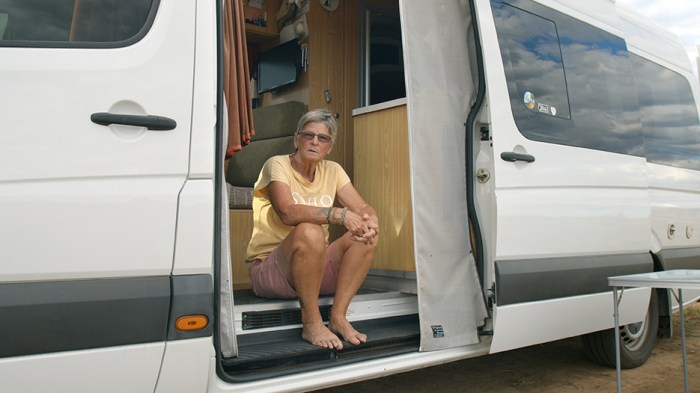
Margaret
“Hopefully the film will offer some ideas of people you can reach out to and contact. And maybe we can start advocating for change.”
Interview by Matthew Eeles
Congratulations on Under Cover. I really wanted to catch this film at MIFF, but I had so many other films that I was obliged to see for interview and coverage purposes. I’m really grateful that I’ve now finally had the opportunity to see this terrific film. How was the MIFF experience for you and the team?
Well, as you know, to get into MIFF is always such a thrill for a filmmaker, especially documentary filmmakers, because we have a really healthy audience there. People come to MIFF to see all films, but there’s always a healthy audience there for documentaries. We were delighted. We had three screenings and at each of them we did a Q&A with women from the film from Brisbane and Byron Bay. I have to say that the response of the audience, even right up to now has been extraordinary. We keep getting emails and texts and people reaching out to us through friends or on the website saying, “I know someone in this situation,” or, “You’ve changed my life. I don’t feel so ashamed of my situation because this sort of thing is happening to me.” So yeah, these early screenings have been wonderful.
I shared the trailer on the Cinema Australia TikTok channel recently and it received over 40,000 views in the first 24 hours and received hundreds of comments. One common question is, “Homelessness doesn’t discriminate when it comes to gender, so why only focus on women?” Do you want to clear that up for us as to why you decided to make your film about this particular group of women?
Absolutely. You must have read the statistic that women over 55 are the fastest growing demographic of homelessness in Australia at the moment. So we’re not saying that it’s a gendered issue generally, but right now, certainly in the last four years since 2018 when this study was done, there’s just been this terrible surge in older women struggling to pay their rent or mortgage or find affordable housing. And the social services working in the sector are just absolutely overwhelmed. I’m a woman over 55. It really struck a chord with me. I was really shocked as a woman who has worked in the arts since I was 18 and I don’t really have superannuation to speak of. And I thought, “Okay, if I didn’t have a stable relationship where we shared finances, this could be me. I’ve got nothing to grow old with.” It really shocked me, and it still does. Setting out to make Under Cover, my co-producer Adam Farrington-Williams and I thought we were going to come up with a solution to this issue, and at the end of Under Cover we’re gonna tell you all how easy it is to solve this problem. [Laughs]. Three years later, I can tell you we haven’t done that. And that in itself was confronting. I’ve been working in the area now for three years and I completely understand how complex it is. And really the bottom line is if governments don’t make social housing a priority, then it’s not going to change. We do not have enough affordable housing in Australia.
You’ve said that when you first set out to make this documentary that you realised very quickly how similar your own story could have been to the women you’re focusing on here. Did that realisation hit you even harder once you started filming, and while you were deeper into this filmmaking journey?
My mum’s a single woman. If it wasn’t for an old aunt who gave her some money, my mum would have nothing. So everywhere I looked, including my two daughters, I would look at them and think, “They work in the arts now and they don’t have any money. What are we doing?” It’s actually a bit scary. And interesting enough, we were working with this incredible young woman who’s an up-and-coming producer, Alexandra Curtis. She started out working with us for the first year of the project. I kept looking at her and saying, “You have got to change your situation.” She was working with us on a tiny little wage and had no money in the bank, and had moved back home because she had no money. I just said to her, “If you get offered a full time job, you’ve gotta go and do it.” And ultimately she did. She left us and it was devastating. She was remarkable. But seriously, if I could do one thing, I’ve gotta remind young women that they’ve got to put some money in the bank. Women, young men, anyone. We need to put money in the bank. It’s vital, but I don’t know if I knew that. I was such an optimist and an idealist. [Laughs].

Mary
This really is a fascinating group of women that you’ve chosen to focus on here. How did you go about finding these people to participate?
Our initial research for the film was reaching out to all the not-for-profits like Housing for the Aged Action Group, Women’s Property Initiative, Women’s Housing, Community Housing New South Wales, all over the country. You’ve gotta make connections with people and then ask them to introduce you to someone. It’s all incredibly sensitive and time consuming because someone will say, “Oh yeah, I think we’ve got a great woman you should speak to”, and then she moves or doesn’t want to be a part of it, and then you have to meet another one. So it was a very long, slow process. I like doing that though. It’s part of the work that I do. I’m not ever going to just shove someone in a film if I don’t know them, or they don’t know me. It doesn’t sit right with me. So there is a time period of getting to know someone, and I share my life and my story a bit with people so they know a bit about me, which I think is only fair before I then shove a camera in their face. [Laughs]. And I always said to them, “Are you aware that potentially this film will be on a big screen or on the television? Why are you sharing your story with me?” And interestingly enough, without fail, they all said they didn’t want this to happen to anyone else, particularly to young people coming up behind them. But even their own friends were concerned that they’d heard about people who were struggling and didn’t know where to go. Hopefully the film will offer some ideas of people you can reach out to and contact. And maybe we can start advocating for change.
Did you notice a particular similarity between these women during the shoot?
Not really. I actually found these people to be quite different. They and their life situations that had led them to this position of either being in housing crisis or homeless or struggling to survive were all very different. Everybody knows there’s domestic violence. There’s the gender pay gap. There’s a lack of affordable housing. There’s illness raising children. Women leave the workforce often to look after children. A lot of women tend to work in those caring roles, which are often not paid the same. We know all of this. And it was just a plethora of mixed stories that ended up in the film. I’ve got a woman representing all the different issues that happened to women generally, and I think I tried to do that without hitting the audience over the head. I wanted people not to think they were being taught something. I tried not to be didactic. I also didn’t want the women to be crying and sobbing and complaining the whole time. So the interviews that I do I often cried, they often cried. But I worked really hard in the edit not to put all that in. It was really important to me that we just hear the stories and we let the stories and the woman say something. I don’t know if you noticed, but I haven’t used a lot of music or sound effects, and it just hangs. And I really like that. I worked really hard on just having those moments of silence in this film, which I’m really proud of.
The film really does stay focused on these women and their story. Did you ever consider approaching higher level politicians and bureaucrats to be a part of the documentary?
I did all of that. I interviewed 17 women and ten ended up in the film. And I interviewed about ten high powered politicians, business people, and so many people working in the sector. Not so much the not-for-profit, but a lot in the business sector and politics. We had a long time in the edit to think about this and in the end I just thought, no, it’s all about the women. And I shredded everyone except some people who are very passionate and do great work. I had some great politicians and not many of them made the cut. [Laughs].
Bravo to you to for letting these women speak for themselves.
Thank you.

Nada
Margot Robbie is a huge star. Everyone’s going to want to know how Margot became involved here?
I’ll just firstly say that not many people are asking me about Margot at all.
Do they know it’s her?
I think a couple of journalists asked me about it during MIFF, but just lately people are just talking about the film and it’s really interesting. I’m delighted because I thought people are only going to want to talk to me because of Margot, but they don’t. During Covid we had to shut down the first year, which was 2020, for a little bit of time. I was at home a lot doing research and speaking to people on the phone. I started thinking about the what-ifs of the film and how I can tell a story if I’m not being able to get out there as much as I’d like. And so then I started contemplating a narrator, and as documentary filmmakers we always go, “No, no, no, no. No voice of God in my film.” [Laughs]. But this is an issue-based film. It’s not just about one person, it’s an issue happening globally. I thought, “Okay, if I’m gonna have a narrator to fill those gaps for me, who could it be?” And so Adam Farrington-Williams and I started discussing who it could be. And of course you go for Nicole or Rachel Griffiths, or someone of that calibre. Some women who are very successful and brilliant. But I didn’t want that. I thought, “No. If I wanted my daughters to see the film, I wanna have someone with a bit more oomph and sexiness who’s youthful.” And as far as my research showed me, Margot seems very committed to feminism and doing good for women. So we just started that long process of contacting her Australian agent here. In the end, Margot wanted to see some work that we’d done. Adam and I sent stuff over to her team to check it, and then somewhere along the lines she said yes. [Laughs]. It was one of the greatest days of my life, I have to say. She was so charming, of course, and humble and grateful. She thanked us so much for making this film and that she’s very proud to be a part of it. We recorded the narration. Here I am in my little front room in St. Kilda and she was in London in a studio and we were doing it all over Zoom. We could see her, and we’d done all the setup for her. She came on and she was just incredible. We had about two hours. She’d had the narration for a month or so and she’d made some changes. Matthew, that was pretty incredible.
She wrote some of her own narration? That’s amazing.
I know. We went back and forth for a couple of weeks on things and the way she felt it should be said. It’s quite a political narration. And the fact that she said that for us, sometimes I’m in awe that we got it.
I know the film will have a cinema release, and will also screen on ABC, but are there any plans to get this film into schools or any other educational institutions to really hit the message home?
We’ve got a massive impact campaign with a great impact producer called Diana Fisk. We bought Diana on when we got funding two years ago. She’s been doing incredible work. We’ve got an impact partner Quest who have come on. So next year we’re going around Australia trying to get screenings in Parliament. That’s one of our big aims to get it in front of the right policy makers and to get it in schools, not-for-profits, businesses, and in front of people who can actually do something in this area.
Have you seen Catherine Hill’s Some Happy Day? I feel like it’s a narrative accompaniment to Under Cover.
It really is. A friend of a friend sent me a link and I watched it. I was blown away. Peta Brady, the lead actress, is extraordinary. The camera just eats her up. I was really surprised because it seemed to be filmed in my area here in Melbourne. So I recognised bits and pieces and also I’ve done a bit of work with Sacred Heart over the years, so I think the film is wonderful and they’ve done really well. That film’s getting a lot of attention. Congratulations to them.
Under Cover releases nationally October 6. $5 from every ticket sold to Under Cover at participating Palace locations on World Homeless Day (October 10) will be donated to the Australian National Homeless Collective.
ADVERTISEMENT: Everything in Between is in cinemas October 20.


 Cinema Australia