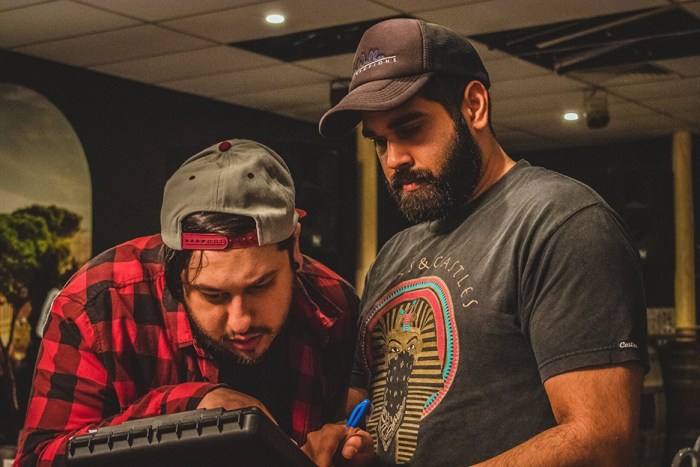
Writer and director Matthew C. Vella discussing shot lists with 1st AD Nilendra Fonseka. Photo by Joey Cruz Andres


Matthew C Vella is an international award-winning filmmaker, comedian, podcaster and entertainer from Blacktown, Western Sydney.
When he’s not writing and directing films, he’s usually talking about them on his podcast Upcoming Attractions, or hosting Western Sydney Filmmakers Hangout, a popular networking group for Western Sydney filmmakers.
As a stand up comedian, Matt has performed at Melbourne International Comedy Festival and Sydney Comedy Festival. He’s not just mediocre looks either! Matt has 3 separate degrees relating to film. This includes a Masters of Media Arts and Production from the University of Technology, Sydney.
Matthew’s new short film She’s Not Your Type follows Barry, a sweet, innocent man who’s on a double date to introduce his mates to his new girlfriend, Alex. But there’s one problem – she’s a mentally unstable, drug-dealing, violent, con-artist scumbag – and he’s blind to all of it! Now it’s up to his friends Sarah & Anthony to save him on the most craziest & dangerous double date ever.
She’s Not Your Type is written, directed and produced by Vella and stars Adrianne Armida, Shane Millward, Zoe Panaretos, Efkan Cetin Supporting Cast: Tyler Busch, Matthew C. Vella, Joshua Vicente and “Whiskers” the Goldfish.
Here, Matthew C Vella gives Cinema Australia readers an invaluable insight into the making of She’s Not Your Type and the challenges of making a comedy.

From left to right: Just of the cast & crew of She’s Not Your Type. Socrates Sam Krinelos, Nilendra Fonseka, David Clarke, Adrianne Armida, Vuk Mikic, Tyler Busch, Luke Walker, Matthew C. Vella, Zoe Panaretos, Terri Ferreira, D.K. Bondad.
“Making stuff up on the spot is a special moment in time and that energy can’t be recreated and faked by any actor, no matter how good they are.”
Article by Matthew C Vella
They say explaining a joke makes it unfunny. I respectfully disagree. As both a filmmaker and occasional stand-up comedian, I love the science and craftsmanship behind jokes and what makes a punchline land. That being said, I’m about to break down some writing and directing techniques for comedy in an incredibly unfunny way. So, writing this article might as well be career suicide. Oh well, I had a good run.
Comedy is more than just telling a joke. It’s the connection, the energy and the fun of what makes us human. I know I’m sounding pretentious, but just hear me out. Some of the biggest laughs you’ll get from a stand-up comedian is watching them doing crowd work or dealing with hecklers. Some of the biggest laughs you’ll get from a theatre performance is probably from an improv comedy show. And there’s nothing louder than a hip-hop crowd’s reaction to a freestyle rapper killing it off the top of the dome. Making stuff up on the spot is a special moment in time and that energy can’t be recreated and faked by any actor, no matter how good they are. So how can filmmakers capture this energy and put it to screen? My short film She’s Not Your Type has won awards for directing, editing and more at film festivals in both the US and Australia. I’ve had festival directors telling me that some of the biggest laughs at their festivals have ever had was while watching this film, and I’ve had a bunch of people tell me it’s the funniest short they’ve ever seen. I’m not trying to brag, I just really want to emphasise the power of making stuff up on the spot, and capturing that once in a lifetime energy via collaborative improv and alternate takes. You know the saying: there’s nothing like the first time.
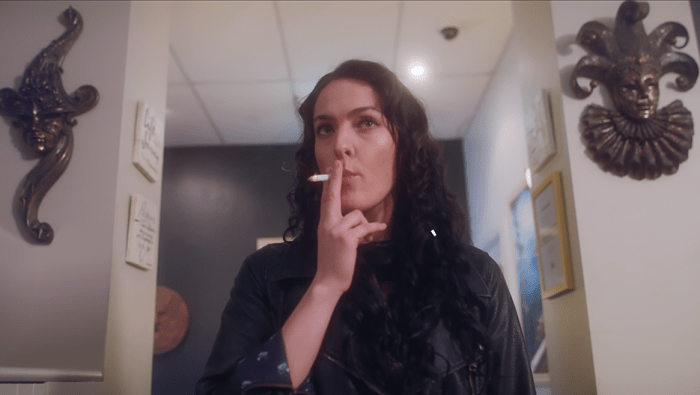
Adrianne Armida in She’s Not Your Type.
Don’t worry, we still had a script. We just worked all that into the structure of our story. For many scenes the goal wasn’t to write the best punchlines. Instead, the idea was to write the best set ups for potential punchlines. For example, in one scene we had two girls in a bathroom gossiping about the size of guy’s….let’s say, appendage? Our script had a few jokes written in, but I only considered these to be placeholder punchlines. About an hour before shooting the scene, I sent my two actors away and told them “write 10 punchlines to this set up and don’t let me know what they are.” Later, we shot the scene with the dialogue as scripted. We all had a good laugh and a good time. After, we kept the camera rolling and I would then read out their alternative jokes, and the actors would perform these new additional lines. Nobody had heard these before, including me, so we were all holding back some pretty big laughs throughout. Once these lines were done, I revealed I had even more written that nobody knew about. We filmed these as well and the laughs continued. I would then take this approach to the next level, by opening it up to the entire crew. Our soundies pitched in, the DOP, production assistants, everybody was given an opportunity to one up each other and contribute. This led to a whole bunch of outtakes, but also it created a real fun energy that really comes through in the performances on screen.

ADVERTISEMENT
This obviously made editing both a dream and a nightmare as we’d have a hundred jokes to choose from, with many of them left on the cutting room floor. We did this in multiple scenes throughout the film, but this wasn’t the only way we worked improv into our script. In between takes, I would listen to the actors talk to each other about the scene, and on a few occasions I would hear a funny comment and suggest they work it into the scene. These would often be small little tags riffing off jokes. Of course, actual improv occurred as well, particularly in our pizza scene towards the end. In the script, it was only a small exchange of a few lines, but the final scene goes for over a minute. In the moment, we just realised that scene kept building adrenaline, and it needed to be longer to make that build up and release feel even more satisfying. So, we just kept stretching out the scene and adding in more and more dialogue. The end result? Arguably the most memorable scene in the film. If we stuck to the script, we wouldn’t have achieved any of that. By allowing ourselves to play with it in the moment, we were able to create bigger and better laughs. If you pay close attention, you can see in some shots the actors are trying not to laugh. And that is all completely fine. Laughter is infectious. That’s why comedians perform for crowds and why sitcoms have laugh tracks. It may sound like a movie sin, but for comedy it’s golden.
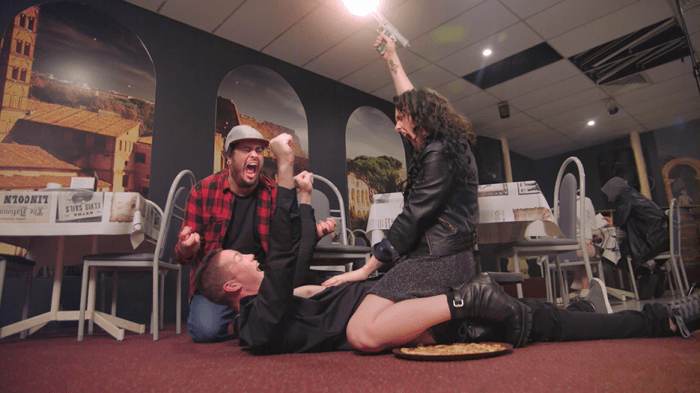
Matthew C. Vella, Tyler Busch and Adrianne Armida on the set of She’s Not Your Type.
Lastly, I should say this only works because our film’s approach to comedy is a death by a thousand cuts. Much like a stand-up set or a sitcom, we have a joke every 10 seconds or so. Very rarely do we have a scene with a long build up to a single punchline. The idea here is to have the audience laughing so much that they could potentially miss the next joke. Not every joke will land, but the more punchlines your film has, the more opportunities it has to get a laugh. I’ve seen a lot of emerging filmmakers have long scenes that build to a single punchline. Unfortunately, I’ve learned this the hard way with other projects that this can be a death sentence for comedy. Because if that joke is a miss, the entire scene is a miss. However, if the scene has other jokes in it, perhaps one of them can save the scene. Comedy is subjective, so you should plan for that and assume not all your jokes are going to work for everyone. The more jokes you tell, the more chances you have for success. Comedy is a numbers game. This frequent joke telling also creates a comedic rhythm for your film. Once you get an audience member into that rhythm, you’re probably going to have them hooked for the rest of the runtime.
I did a lot of comedic experimentation with this project, and I’m sure there’s a lot that doesn’t work just as much as what does work. I’ve tried a lot of other approaches since, but I still feel that these placeholder punchlines and alternative takes have led to the most fun I’ve ever had on set. That energy really comes through on screen, and when done in succession one after another it just has audiences in stitches. For those looking at writing or directing a comedy project, I highly recommend giving this workflow a try. You won’t regret it.
Be sure to watch the film She’s Not Your Type embedded below, and for a better idea of our approaches to alternative takes, be sure to watch our outtakes reel as well.
Learn more about Matthew C. Vella at: www.vellamatt.com
ADVERTISEMENT: Everything in Between is in cinemas October 20.

ADVERTISEMENT


 Cinema Australia