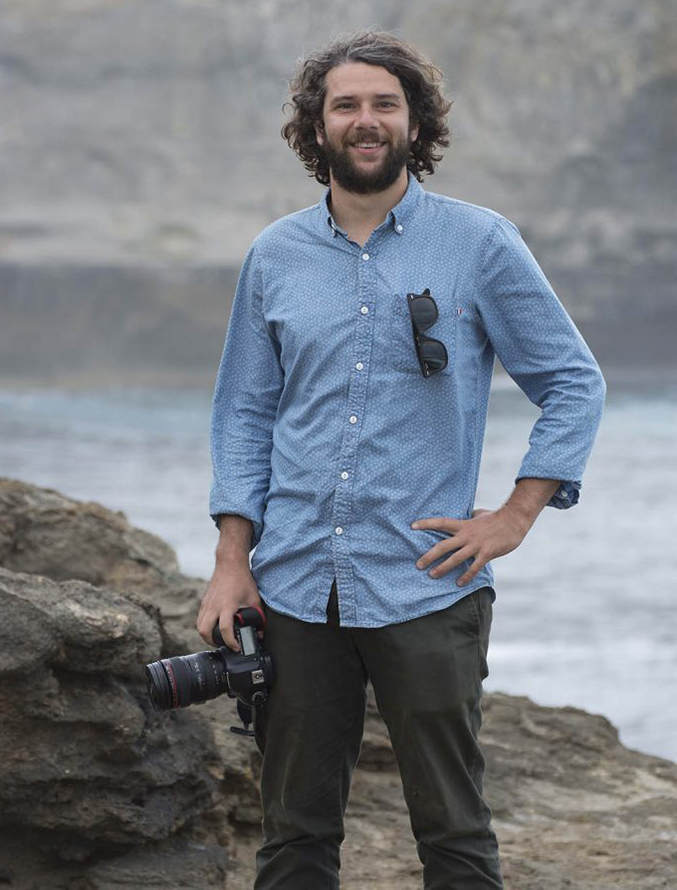
Clean director, Lachlan McLeod.
Help us continue to cover more Australian films by making a donation to Cinema Australia below.

Trauma cleaners clean spaces that no one else will touch – hoarder sites, meth-labs, murder scenes, deaths and suicides.
They clean the homes of some of society’s most vulnerable people – the neglected, the lonely, the addicted, and the mentally unwell.
When illness forces her away from her beloved trauma cleaning business, Sandra Pankhurst faces up to her traumatic past and begins a search for her birth mother. Meanwhile, her workers approach this difficult work with camaraderie and humour, bringing hope to their clients despite carrying trauma of their own.
Clean shows us that life is more fragile than we might think, but there is hope and reassurance in human connection.
Cinema Australia recently caught up with Clean director, Lachlan McLeod to discuss the film.
Clean will screen at CinefestOZ Thursday, 25 August. Details here.
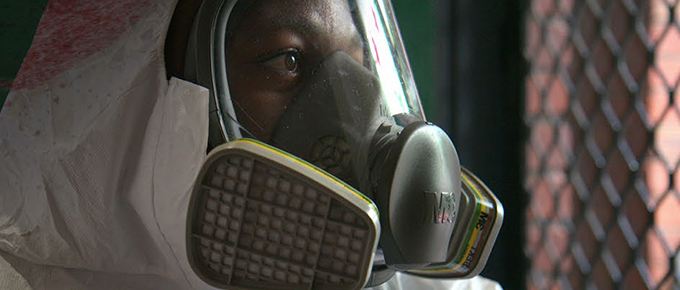
Trauma cleaner Brian.
“Once we’d done a bit of filming our relationship grew and we’d regularly speak on the phone. I’d just call up to see how she was and it became that kind of friendship alongside the filming.”
Interview by Matthew Eeles
When did you first hear the name, Sandra Pankhurst?
It would’ve been a few months before we started filming, which I think was late 2000. I know there was the book, The Trauma Cleaner, released about her, but I hadn’t read that. I’d actually initially seen Sandra in a short documentary that SBS made on The Feed, maybe a five or 10 minute thing. And it very briefly went into some backstory on Sandra, but also a bit about the hoarding. I just felt like there was so much more that could be explored in this idea. And then, of course, as a documentary filmmaker, you’re always seeing who lives near you. We lived in Melbourne and I was like, “Oh, Sandra lives in Melbourne.” This stuff is really interesting and we don’t really know much about what a trauma cleaner does, or what that job entails. Very shortly after that I emailed Sandra and she was very prompt with her response, so we went and met her.
So you were learning about Sandra’s past life as you were filming?
Yeah, we had no idea about Sandra’s past. We were only interested in the trauma cleaning side of her life. We thought that world was fascinating. But Sandra would say things like, “I’m doing this public speaking event. Do you wanna come along?” And I’d said, “Oh yeah. We’ll come along and film it.” She loved announcing information to us through those events in a very dramatic way. She’d be like, “Oh, I’m going to find out who my mother is on Tuesday.” And I’d be like, “What?” [Laughs]. And then she’d suddenly call me and she’d say, “Oh, I’m just in the emergency room of the hospital.” And she’d have had this near death experience. But those elements with her health, and her search for her family, and the public speaking, those were unplanned and happened organically during the shoot.
As an audience, we get to spend an hour and a half with Sandra, but you obviously spent quite a few years with her. Can you describe Sandra to us, from your point of view?
Sandra is very sharp witted, very funny. She likes to be in control of the room and the situation. But she’s also very compassionate and very understanding of people’s situations. That said, she’s also the boss. She runs a very tight ship and had high expectations of her staff. She has extremely high expectations for herself and she put some of those expectations onto the staff as well which made STC such an amazing workplace. They’re all highly skilled. She’s was a very gentle, compassionate person. If she was in the room with just you, or in a room of 10 people or a hundred people, she’d be cracking jokes. She’d be trying to make everyone laugh the whole time. [Laughs].
If anyone can be excused for being untrustworthy of people in general, it’s Sandra who has every right to be considering what she’s been through throughout her life. I’m curious to know how you built trust with Sandra?
We jumped straight into filming. So that first meeting at Specialised Trauma Cleaning where she’s giving us that short tour was the first time we’d ever met her. It was because at the time we were just envisaging it as a short film and we wanted to get a sense of the place. We kind of felt like we’re going to ask her all these questions anyway, so we may as well film it. In terms of building the trust, I think the whole thing was about building trust. This whole thing has been a three year process. It really did take that time to, I guess, start talking about things on a deeper level, and to get more personal with Sandra that wasn’t just about the trauma cleaning. As you can imagine, when she started dealing with very personal things, like her adoption, and her own health, those became conversations in themselves. And once we decided to make it into a feature film, and we’d done a little bit of filming up to that point, our relationship obviously grew and we’d regularly speak on the phone. I’d just call up to see how she was and really it became that kind of friendship alongside the filming. In terms of the documentary, it was all about what she was comfortable with and the kind of avenues she was open to.
I guess in a case like this, it’s not just yourself who Sandra has to build trust with, but also your entire crew.
She loved having thew whole crew around. But at the same time, with the more personal things, or the things that were still quite tender, that’s the stuff that she took maybe two years to warm up to. Whereas that surface stuff, like her past trauma, she was very comfortable talking about, and making jokes about because she’s very, very funny. She was very open with all of us, especially after a few years. We were only a small team.
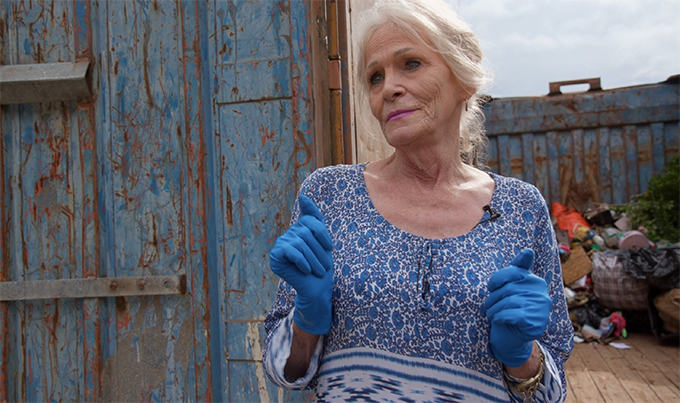
Sandra Pankhurst. Photo by Louis Dai.
I really enjoyed hearing Sandra’s story coming directly from Sandra. There’s no narrator, and your questions during interviews are only heard when necessary. It makes the film feel so much more personal. Is that a decision that was made during the edit?
Yeah, very much so. I think we always aspired to make the film in that way, by not having a narrator. But it does make it so much harder, in a sense, because although you wanna put in your own perspectives and voice in a film, you’re forced to do that through the people. In this situation, Sandra is such a great voice to hear her own story through. We really were quite lucky in the end with that because as you pointed out, so much of the story is held together through this master interview that we had. That master interview with Sandra was one of the last things we were able to shoot with her, even though she was getting so sick. We had to cancel that interview and reschedule it maybe two or three times because she’d be in hospital. We weren’t really sure whether we were going to be able to get it. This film would be a very different film without that interview.
This field of work can have a deep impact on the people directly involved in it, and workers featured in the film like Brian, Chris, Rod and Kellie all have their moments throughout the film to talk about how it affects them. But what we don’t see is how this experience impacts you and your team behind the scenes. What was it like for you to attend some of these homes of either hoarders or even murder victims in some cases. How did you prepare for that?
Yeah, it’s confronting and intense. In terms of the crime scenes, there’s a little bit of a technical trick in that. We didn’t actually attend that particular crime scene in the film, but we definitely would film these people all the way up to the point where they got to the crime scene. But for legal reasons we couldn’t go in the house. We saw some pretty hard stuff in terms of the domestic clients who didn’t end up making the cut. And some of the hoarding jobs are quite emotional to deal with. Especially the jobs where people have passed away in a room. We were there for three or four days, and we were just figuring out who they were by seeing the remnants of their lives. So that was quite confronting. And then other types of hoarding jobs where there’s squalor involved were confronting in a different way. The staff are used to things like the smells on sites, but, for us, there were a couple of shoots where we really had to leave the room because we were really trying hard to be respectful and give dignity to hoarders. But at the same time there was faeces all over the floor and I just had to leave. I’d say it was a window into the job, and it was confronting at the time we were doing it. It made me realise that I could never do that job myself. I was thankful that we were there days at a time and not coming back every day to those kind of things.
I mentioned the workers like Brian, Chris, Rod, Kellie whose lives we get a quick glimpse into throughout the film. What kind of person do you have to be to work in trauma cleaning?
One thing they all talk about is the importance of showing compassion for these people who require this kind of service, and the fact that they’d gone through this kind of stuff themselves, not to the same level, all of them, but to some degree. Sandra had gone through hard times, obviously. This is a way for these workers to deal with their own hard times, to help other people through hard times. So, in a sense, their work becomes a healing exercise for themselves. They also all have the right type of personalities. A lot of them were matter-of-fact people. It is hard to generalise because everyone was different, but a lot of them rarely reflect on why they do it. Whereas I know if it was me, I’d be thinking for weeks about a horrendous crime scene I’d just seen, whereas they seem to be able to handle it. In the documentary we do spend a bit of time focusing on the mental health issues resulting from this kind of work.
And again, the film goes for an hour and a half, and we only spend a limited time with these workers, but it seems like a genuinely nice working environment. There doesn’t seem like there are a lot of office politics going on.
Yeah. I mean, you get your normal kind of day-to-day politics, but definitely in terms of the type of work they’re doing and just how intense that must be. They all get along so well and they all support and help each other through their work as well. It was a nice vibe.
We’re introduced to a few interesting characters throughout the film who all seem happy to be filmed, including Devon who’s moral perspective comes across as being aligned with Sandra’s. Can you tell us a bit more about Devon and his approach to being a part of Clean?
Devin is a regular client of STC Services and he’s a heroin addict. STC have to regularly go and clean his house because there’s needles all over the floor, and that’s just how he lives. Devon himself has quite a personal relationship with some of the staff who knew him even before STC. Chris, who you mentioned, was one of Devon’s case worker when he was homeless. Without going into detail, Devon’s had a very hard life. He has suffered immense trauma. He has been in and out of prison. He now has this drug addiction to deal with those traumas and deal with the things that he’s he’s had to go through. He appears in the documentary at a time when they have to move him on from his house because of the mess that his addiction has caused. He has an outburst to camera, which is one of the more powerful scenes in the documentary.
It certainly is a powerful moment in the film, and it’s one that has stuck with me. Chris and Gayle are another very likable couple in the film. Did you let Chris and Gayle know that their song Black Jacket was going to be used during the credits for the film? I assume you’ve let them know.
Yes. [Laughs]. Yes. And they absolutely loved that idea.
It’s a catchy song. I’ve watched the video clip on YouTube since. [Editor’s note: You can watch the clip by The Odd Bods here]
[Laughs]. I can’t wait for them to see it. I’m not sure if they’re coming to see it at Melbourne Film Festival, but we’ll definitely get them along to a screening, as well as everyone else who was involved in the film. Also Sandra’s son’s family. We’re very excited.
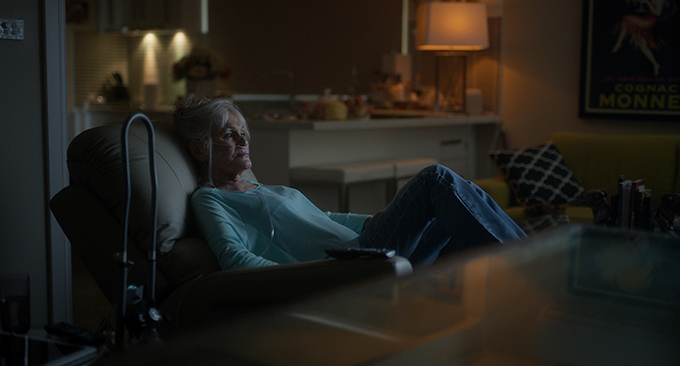
Sandra Pankhurst. Photo by Louis Dai.
How hard is it as a documentary filmmaker to inject yourself into someone’s life so intimately, then remove yourself from it once the shoot is over? How long do these people stay with you? You will be living with it for a while yet as the film travels, but there will come a time when you have to let it go.
With someone like Sandra, who I’ve spent so long with, and then some of the workers who I would say I’ve built a friendship with, it has been especially hard. That’s a hard dynamic because I made a documentary about such a personal aspect of their lives. I guess an easy way to explain it is that it’s like going to university, or school, with these people and we’ve had such a great time. And then that time ends and you don’t see them again. I genuinely hope to stay in contact with some of these people, for sure.
The flashback scenes throughout the film are quite impressive. Did you shoot them yourself?
The flashback scenes are another layer that we added at the very end. Clean is more of an observational-style documentary in general. It’s very run-and-gun for most of it. But as we headed towards the end of production we decided that we wanted to add some visual reference to past moments from Sandra’s life. And also a few other stylised moments. For this we put together a team with more narrative experience and style. I think we had 18 people. We had a few different DOPs on it who’s style we liked. A much larger teams than just the three of us who shot the documentary aspects of the film. So those scenes were a great experience for us because we’d never worked with that size crew before. And obviously everything had to be planned and we had to know exactly how it was going to be used in the film at that point. That was its own experience itself. The person who normally shoots on the run-and-gun stuff hadn’t had that experience before. So we found two people who’s style we loved. We were actually filming a lot of this stuff during and in-between lockdowns, but we’re really happy with how it all turned out.
It’s becoming a cliché for film media to ask how Covid impacted a production, but for this film it’s particularly relevant because it played into Sandra’s life quite dramatically. How much of a hit did Clean take during that time?
Yes, it plays a big part in the film’s narrative that’s for sure. This film exists during that time. We would’ve been filming a lot more if the lockdowns didn’t exist during a certain period of time, and it probably pushed the whole project back six months or so. But I think the biggest affect it had on us was just the dynamic with Sandra, because Sandra was so unwell at that time with the progression of her lung disease that if she had of gotten COVID, it really wouldn’t have been good. So that meant everyone being very, very cautious around her and, without giving too much away, it also affected what happens in the film with her. Covid definitely had a huge impact on our production.
Clean will screen at CinefestOZ Thursday, 25 August. Details here.

ADVERTISEMENT

ADVERTISEMENT


 Cinema Australia