
Mark Hartley on the set of Girl at the Window.
Help us continue to cover more Australian films by making a donation to Cinema Australia below.

When Mark Hartley’s video connected during our recent Zoom interview, the first thing I noticed was his enviable collection of Australian movie posters which lined the wall behind him.
Posters for films including Wake in Fright, Alvin Purple, Picnic at Hanging Rock, and Razorback which were all signed by the filmmakers during interviews for Hartley’s highly acclaimed debut feature documentary, Not Quite Hollywood.
“I took all of these posters along with me while we were doing Not Quite Hollywood. My Wake in Fright poster is signed by Ted Kotcheff,” Hartley proudly points out to Cinema Australia.
“It was so great to be be able to talk to these people and then pull out the poster at the end of the interview.”
The posters, along with a massive collection of DVD’s that lined the shelves below them, are a reminder of Harley’s encyclopaedic knowledge of not just Australian movies, but cinema in general.
Following a long and successful run directing music videos for bands like TISM, Peter Andre, You Am I, and even Bardot, Hartley began directing documentaries on classic Australian films like The Club, Pacific Banana, Turkey Shoot, and The Adventures of Barry McKenzie working in collaboration with Peter Weir, Bruce Beresford, Gillian Armstrong, Fred Schepisi and Phillip Noyce.
I’m not going to lie, for someone who calls their publication Cinema Australia, it was slightly intimidating to interview someone with such an extensive knowledge of Australian cinema.
“You certainly shouldn’t feel intimidated at all because there are far more filmmakers out there with a better pedigree than me,” says Hartley.
I asked Hartley where his passion for Australian movies comes from, and why he wanted to express that passion through Not Quite Hollywood.
“I grew up watching Australian films on TV. I loved them because they seemed like the American films that I love, but with Australian accents. I also got to know Richard Franklin when I was in high school. He served as a friend, and as a mentor to me. I could never believe that a guy who had made so many great films as he wasn’t in the Australian history books. And same, to a large degree, with Brian Trenchard-Smith and people like that. I got to know them more and more and I just felt that was a story that needed to be told. And if I wasn’t gonna do it, no one was. I did have a burning passion to certainly make that film,” says Hartley.
I was curious to more about how Hartley met Franklin during his school years.
“I found out that he’d gone to the same school that I’d gone to, and I found his address in the registry and rang him up and invited him to come and talk,” Hartley remembers with a big grin on his face.
“That was when he made Cloak and Dagger, so I was probably around fifteen. We stayed in touch and he recorded his interview for Not Quite Hollywood, I think two or three weeks before his death. So it was a very, very moving and emotional time for me. That’s why I dedicated that film to Richard.”
Following Not Quite Hollywood, Hartley paid the ultimate tribute to Franklin by remaking his classic 1978 horror thriller, Patrick. The film didn’t make a lot of noise at the time of its release, but it’s certainly worth a revisit.
Nine year’s later, Hartley returns to the big screen with his latest film, Girl at the Window – a gory killer-next-door thriller that leans into all the best genre tropes.
Girl at the Window stars Radha Mitchell, Vince Colosimo and an impressive feature film debut from newcomer Ella Newton who plays Amy – a teenage girl who’s struggling to cope with the accidental death of her father. She suspects that the mysterious killer stalking her hometown is not only her neighbour, but her mother’s new romantic interest.
Here, Hartley gives us the lowdown on Girl at the Window.

Ella Newton in Girl at the Window.
Interview by Matthew Eeles
I think you’ll forever be known as the guy who made Not Quite Hollywood, and for good reason. But to me you’ll also be known as the guy who had the balls to remake Patrick. It’s been nine years since that film was released. How do you reflect on that experience now?
It was great. It was amazing. You know, you get to a stage in your career where you go, “Well, maybe I never will make a narrative film.” I’d certainly gotten to that stage. I worked with Tony Ginnane, who people certainly don’t hold back their opinion of, especially in Not Quite Hollywood. And then there we are making a film together. All of that criticism of Tony in Not Quite Hollywood was water off a duck’s back. You’ve gotta give credit to Tony for Patrick. He was relentless in pursuing finance for that movie. He was saddled with this first-time narrative filmmaker. I’d brought along my DoP, Garry Richards, who had never shot a feature film before, and Justin King who had never written a feature film before, and Tony managed to get it financed. We also got a great cast to boot. So every day was like a dream come true for me on that shoot.
Have you watched Patrick recently?
I put the blu-ray together about a year and a half or so ago. So I did revisit it when I was putting that together. A few of the CGI things are a bit stodgy, but then they were always meant to be. I always wanted it so the audience knew that they were watching something in a film world rather than reality. I wanted things to look like old fashioned matte paintings. A lot of people didn’t get that. I would’ve thought as soon as people heard Pino Donaggio’s score that the sensibility of the film would’ve been well and truly announced. [Laughs]. I think it holds up pretty well. What I like about it is that it’s it’s own entity. I never really thought that we were making someone else’s film. We always thought that we were making our own film.
So are there any more Ozploitation remakes in your sights?
Well look, we did start on an on-paper remake of Fair Game. And then we took the basic premise and made very much our own movie out of it. It’s a project we had called Red Morning which was the film we hoped to do after Patrick, but it was just so big. It’s basically a chase film through the Outback. We sort of pitched it as Dead Calm meets Duel in the Outback. That was the project we’ve been working on for the last nine years, trying to get up. It was just proving very, very difficult. So it was when I said to Tony, “Let’s find something a lot more modest that we can just jump into and do.” And that’s where Girl at the Window came into play.
It’s rare for Australian films to be re-made. There’s a Wikipedia page that lists only six Australian films having been remade including Turkey Shoot and Storm Boy. Interestingly it doesn’t list Patrick, so maybe there are a lot more out there.
You’re right. Jamie Blanks did Long Weekend. I think they’re remaking BMX Bandits which they’ve certainly received some sort of production investment to remake.
I could see BMX Bandits playing well to a television audience at the moment.
There was a slew of kids films from Australian, a lot of them produced by Robert Connolly, that found very enthusiastic audiences, so to me it’s a no brainer for someone to take on BMX Bandits.
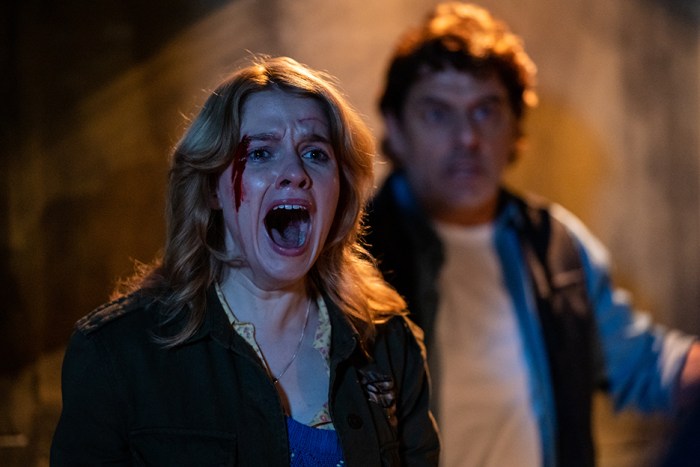
Ella Newton and Vince Colosimo in Girl at the Window.
I genuinely enjoyed Girl at the Window, and Ella Newton is so exciting as a performer. Killer-next-door is a sub-genre of horror and thriller films, and I guess they have been since Rear Window, and I’m sure even before that. Why were you so keen to explore this particular genre?
Tony gave me this script for this film called Eyes. I really liked it and it was a real page-turner. I knew we could pull it off on a modest schedule and I knew we could have fun with the tropes. I love that combination of killer-next-door mixed with teen who cried wolf. The killer next door goes back all the way to the Bobby Driscoll movie The Window in 1949, and, like you say, Rear Window and Road Games, Body Double, and Fright Night and Cloak and Dagger. It’s a genre that I’ve always loved
Did you rewatch any of those movies for inspiration?
I don’t think we did. On Patrick I remember we had such a big window ahead of the shoot. We had signed Charles Dance, and he only had a certain window when he wasn’t shooting Game of Thrones. So I think we literally had six months where Garry Richards and I could sit down, watch a whole stack of movies and work out what our inspirations were. My script for Patrick has references all the way through it of screen grabs from other films and so forth, but we didn’t have that time on Girl at the Window. We just literally sat down and shot listed it from start to finish. We always had our love of those films in mind, but we were also trying to find our own voice for this film. That’s not to say that it doesn’t certainly hark back to Brian De Palma’s work and there’s obviously lots of inspiration points there. Robert Wise as well.
The film was written by Terence Hammond and Nicolette Minster. Did you make any changes to that original script?
We did, we did. We culled the script quite dramatically from the first draft that I read. We took the backstory of the killer away. There was quite an elaborate backstory for the killer, which I figure people are quite happy to accept nowadays knowing that there are just evil people out there in the everyday world. You don’t really need to know the whys of all that stuff anymore. And that original script was a lot larger in terms of set pieces in a hospital, and there was an ambulance chase. It got to a point where we knew what our schedule would be, and it was like, “Do we make this big film badly, or do we compress it all and try to make a much simpler story as well as we can.” And so that’s what we decided to do. We did take a large part of it out. In terms of scenes that are mine, the pre-credit sequence with the girl in the photo booth, that’s mine.
I knew it. That scene has Mark Hartley all over it.
[Laughs]. I think that’s probably the only one that I thought the film really needed. It’s a real moment to grab the audience. So I came up with that, but everything else is the work of Terrence. Terrence plotted the whole thing and wrote all the suspense sequences, and then Nicola came in and did a polishing of the script to give the teenagers an authentic voice.
You mentioned the killer’s backstory which was cut from the script. Did that include more about the butcherbird?
The film was originally called Butcherbird. That’s the title that I really wanted to give it. The sales agent didn’t like it. And so it went out with a slightly more generic title. [Laughs]. I’m not necessarily sure the butcherbird was more of that original story, but I think when the title was Butcherbird, the audience might have paid a little bit more attention to the Butcherbird elements in the film.
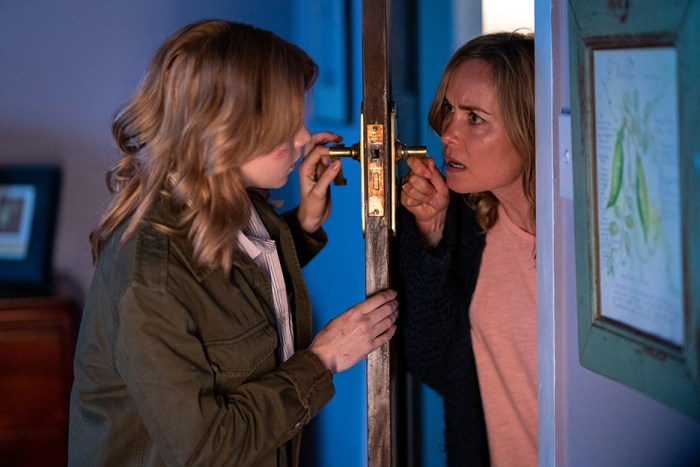
Ella Newton and Radha Mitchell in Girl at the Window.
You’ve got yourself one hell of a cast here. Both Vince and Radha are terrific as anyone would expect. But I want to know more about Ella Newton, because she can certainly act. Tell us about working with this incredible young actor.
I got sent a stack of auditions on tape from people to play the lead. I thought Ella was fantastic. She was so natural and she had a great look. She looks like a real person. She looked like the girl next door, and she could be a little bit mousey and a bit insular when she needed to be. When we did auditions for her best friend, we did them with Ella and Karis in a car, and they just had that chemistry from the moment they opened their mouths. In hindsight, knowing how well they work together, it’s a shame they don’t spend more time together in the film. They were so enthusiastic and excited about making this film. Nothing was too much trouble for them. We shot during lockdown, in the middle of a pandemic and even that didn’t dampen their spirits on set. So that was great.
Watching the film, I noticed so many similarities between Radha and Ella. They could easily pass for mother and daughter in real life. Did that come naturally between them, or was that instructed.
I think that’s the best thing. I think the highest compliment you can play to Radha is that you really do believe that she’s the mother of Ella. It’s interesting because with COVID safety rules, they didn’t really spend any time together prior to the film. We literally had two days with the cast to come in and just discuss the script. We didn’t do a table read or anything. We just sat down and went through various scenes and talked about characters and then literally they were on set. I mean, that was the main difference between making this film to making Patrick is that there was a real sense of camaraderie that developed, because you could spend a lot of time outside of the film with your cast, whereas you couldn’t do that here. As soon as we finished filming, we had to go home. We didn’t have welcome drinks. We didn’t have a wrap party. There was none of that. On one of the last days of Radha on set, we were sitting opposite each other during lunch and I said, “You know, I really don’t know anything about you.” And I realised that’s because we hadn’t had any time to chat. Even between takes, we had such a tight schedule that we were just moving and moving and moving. There was no idle chatter. I was on set the whole time. We were just getting stuff done and there was no time for any of the niceties that would normally happen on a shoot.
I’m curious to know more about a certain scene that caught my eye. Can you talk us through the scene when Vince’s character confronts Ella’s character for the first time. She’s using a wheelbarrow to peer into his shed window, and when she falls the wheelbarrow gets flung into Vince. I could be reading too much into it, but it looked like Vince took a genuine hit there.
[Laughs]. Good pickup. Well there are no VFX or anything in that shot. We had the wheelbarrow on a rope and we pulled it away from the shed towards Vince. You can actually see it sparks as it hits the brickwork and Vince just took the wheelbarrow like the professional he is. We did it in two takes and each time he slammed himself into the wheelbarrow. [Laughs]. I don’t think I’d say any scene was more challenging than any other. The whole challenge was that we had nineteen days to shoot the film. We had nineteen ten hour days and we knew what we didn’t get wouldn’t be in the film. The script was so paired back and tied at that point that if we lost a scene, nothing would make sense. So the challenge was just getting through the day and knowing what we needed and what we could discard to be able to still tell the story. This isn’t a film where it’s shot handheld with very naturalistic light. This is a film that has everything on tracks and dollies or cranes. It’s kind of got a very old school Hollywood style to it. Everything is lit like a traditional genre film so we couldn’t cut corners anywhere. We just had to keep on moving and just hope that we got enough to tell the story. And not just enough to tell the story, but enough to tell the story where every so often it would have some style to it as well.
How much fun was it to shoot some of the more violent scenes in the film. I get the feeling you’re the kind of filmmaker who has a lot of fun with that stuff.
So much fun. I think the truly original moment in this film is where you see the eyeball pulled out from inside the head. And that was an idea I had. From memory, I had never seen that in a film before. I thought it would be as simple as possible. I thought we’d cut a slit in a bit of cardboard and we’d just pull an eyeball through it and that would be good enough. But the special effects makeup guy came up with this huge mechanism and a giant eye and a big plastic retina flap. It was amazing seeing that work for real. On set it didn’t seem gross or anything, but on film, it certainly has an impact.

Ella Newton and Vince Colosimo in Girl at the Window.
What’s your take on modern horror, and in particular the A24 school of horror. As much as I love some of those films, more often than not it takes so long to get to the point. Whereas with a film like Girl Next Door, we’ve got a bloodied corpse in the opening scene.
Genre films have changed quite dramatically recently. It could have always been like this, but I think from The Witch onwards, it seems now that there are two very distinct type of genre films. There are very, very arty genre films, and there are very, very, very extreme genre films. And they’re the genre films that play all the festivals. You don’t see anything in between. And when we set out to make this film, we wanted to be firmly in the middle of that. Ours is much more of a throwback. It’s not overly arty. It’s not overly graphic. It’s made in a way to appeal to people who don’t really seek out genre films. You could easily stumble across this film and take it in by the characters and the story and the the genre elements are just secondary to that to some degree. I think you’re right. I think things have changed a lot, and particularly with A24 who are making an extreme style of genre film.
Do you have any interesting neighbour stories of your own?
Sorry, I had to think about that for a moment because I thought you were asking me if I have any interesting Neighbours stories, because I did work experience on that show when I was in high school. [Laughs]. But going back to your question. I lived in Endeavour Hills when I was a kid and on a property just next to Endeavour Hills, which was called Police Paddocks, there were two killings. The “silver gun rapist” was what it was called. And I’m sure that guy lived on our street because as soon as this guy moved from up the road, they all stopped. So I might’ve been living on the same street as the silver gun rapist.
Girl at the Window is in cinemas August 18.
ADVERTISEMENT

ADVERTISEMENT


 Cinema Australia