
Rasmus King and Macario De Souza on the set of 6 Festivals.
Help us continue to cover more Australian films by making a donation to Cinema Australia below.

Everyone has that one music festival memory they’ll never forget.
For me, it was the 2003 Big Day Out in Perth.
I had made my way to the very front row to see nu-metal survivors, Deftones. Mid-way through the set the crowd surged forward. I lost my footing and fell to the ground. I was being trampled, and no one tried to help me up.
I remember thinking, “If this is how I’m going to die, at least I’ll go out to Deftones.”
Out of nowhere I saw a hand reaching for me through the crowd. It was Deftones frontman Chino Moreno. He helped me to my feet and back to the railing where I continued to mosh out for the rest of the gig.
It’s a moment I’m grateful for, and one that will stay with me for the rest of my life.
For musician and filmmaker Macario De Souza, his favourite festival moment is much more sentimental.
“My favourite festival moment would have to be my first ever festival. I think I was 14 and it was one that the older Bra Boys had put on called Surf Skate Slam,” De Souza tells Cinema Australia.
“I think it was 1997. I’d never seen anything like it. And at that point it was some of the biggest bands at the time. It was Frenzal Rhomb, Silverchair, Grinspoon. There was a big dirt skate ramp with some of the best skateboarders. There was a surf comp going on on the beach with some of the best surfers. It was just the most visually stimulating and audio stimulating experience. We had our first fight, I had my first kiss, everything about it was just an experience that we would never forget as a bunch of mates.”
Music festivals are a rite of passage for most Australians, and De Souza has built on those experiences for his latest film 6 Festivals which follows three best friends, Maxie, Summer and James, who create a music festival bucket list when they find out James has cancer.
The result takes the audience on a pumping film experience like no other as Maxie, Summer and James make their way to the different festivals while meeting bands along the way like Dune Rats, Ruby Fields, G Flip and Bliss n Esso.
6 Festivals is the first feature film for De Souza following a handful of very successful documentaries including Bra Boys, which was narrated by Russell Crowe and currently sits as the second highest grossing documentary in Australia.
As well as being a filmmaker, De Souza might be better known to others as Kid Mac, a musician with two studio albums to his name who has toured the world with artists like Wu Tang Clan, Snoop Dogg and Mickey Avalon.
In the below interview, De Souza discusses drawing on his own musical experiences for 6 Festivals, working with an extremely talented young cast, including Rasmus King – who will appear in three Australian films this year, and a television show – and how he convinced his band friends to be in his film.
6 Festivals is in cinemas from today, and will also screen as part of the CinefestOZ program from Thursday, 23 August. Details here.
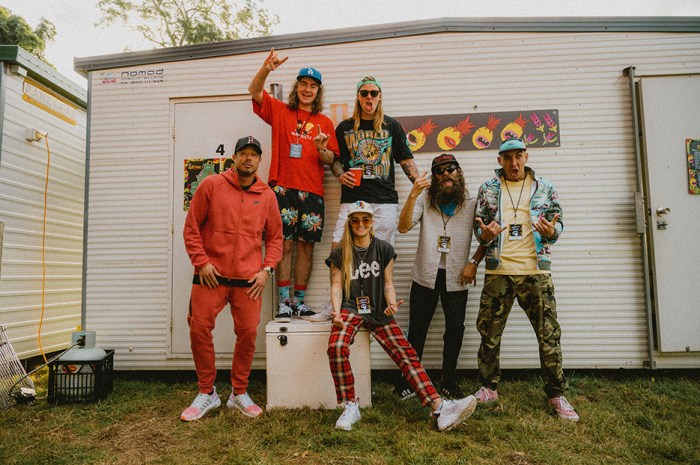
Bliss n Esso, Dune Rats and G Flip on the set of 6 Festivals.
Interview by Matthew Eeles
6 Festivals recently premiered in Australia at the Sydney Film Festival. How was that experience for you?
The Sydney Film Festival premier was probably up there as a highlight of my career. The energy in the room was incredible. The cinema was an 850 seater. We packed it out, and we had a lot of the cast and obviously all the bands in the film were there. There was a lot of singing along and clapping and cheering. It was just the right energy for that type of film. It was the perfect way to kick off the campaign. We went on to have a few more screenings through the Sydney Travelling Film Festival, and then I just got back from Melbourne last night from the Melbourne International Film Festival, and that was a great reception down there. So it’s good, man.
How has the difference been in response to this film and your first film, Bra Boys?
If we go way back to Bra Boys, the premier of that was very similar to this film, with the energy we received. Bra Boys was high octane, you know? Higher level excitement. But that’s only because there were so many people anticipating that doco for so long and it was a part of a big community. So there was definitely a celebration energy in the air which was similar to this. Fighting Fear was similar. 6 Festivals was a massive leap though. There’s so much more involved in getting a drama up and it’s challenging. So I think from a media perspective, I’m feeling like it’s being respected a lot more and there’s a lot more attention’s being paid to it which is interesting. In the past, I’ve kind of taken a bit of a backseat given my age and my roles, and I’m just slowly coming into my own. This is a story that was super personal to me and something that I’ve had my hand in from start to finish. After all these years of hard work, things are starting to come to fruition for me, and people are starting to notice that. And that’s a nice feeling too. Having the cast come along with me, and my creative team, it just feels like a really good collaborative celebration with this one.
6 Festivals is your first narrative feature film following a very successful career making documentaries. When did you know it was the right time for you to make a feature film?
I’ve been wanting to do it for a while. It was really about trying to find the right story and obviously getting told constantly to write what you know. I tapped into something that was super personal, and something that I knew I could bring something potentially that not many other filmmakers could pull off, particularly coming from the world of music myself as a touring artist, and having those ties with all the artists the industry and the festivals. Like I said, I just don’t think too many could have pulled it off. And so I thought, well, here’s something unique. Let’s explore that. Upon first pitches to people in the early, early stages, it obviously got a little bit of interest. It was then down to making sure that the script was tight. And that’s what probably took the longest. I probably didn’t really back myself as a writer to start with, but as we progressed through it through the years it got to a point where I just grew in confidence and really understood that this was a story that was from my world, and the characters, and the voices, and even the dialogue. It was just something that I grabbed the bull by the horns towards and just really brought it home and finished the script off. I guess the funding process obviously was another tedious one. Once we got that all locked in it just kept growing. It really solidified the whole project. And once Paramount + came on board, it meant we knew that we had a home for it. They understood the fact that this was for a young audience. They felt it was the type of film that would be great as their first original local film to launch their Australian platform.
This is a fairly unique Australian film. I can’t remember another film like it in terms of how it was shot and composed using live festival footage. It got me wondering what films, if any, you were using as a visual reference or inspiration.
I didn’t really use any other festival films as inspiration, but I did very much lean on two films. I kept referencing them with our DoP, Hugh Miller, and the cast, and they were American Honey and Jonah Hill’s Mid90s. American Honey was more visual for me. It’s saturated in beautiful, summery, warm colours. The fact that the camera was with this group of young people in this van on the road. As an audience member, you were on this journey and it felt super authentic and not contrived. So I pulled that from American Honey. Mid90s, for me, it was more tonal in how the friends just popped on screen and that felt so authentic between the skateboarders and the older brother. Just the nostalgia of that world really struck a chord with me. I used those two films a lot as really good references. Visually, from the festival side of this film, we tapped into our understanding of that space, and shooting a lot of festivals over the years and making sure that the energy was maintained and that that was intertwined with the tone of our film.
How challenging was it for everyone to maintain that energy across those festival scenes?
My non-negotiable with this project was always pitching it as something that had to be shot at real festivals, and bands had to come out themselves. I didn’t want any pretend bands. A lot of music films, I feel, fall short and get a little cheesy because they have to work around those little things. Through my ties I was able to encourage the bands to be themselves and use their brands, and to bring that energy and excitement that they already bring. And so that energy came from being in that real world, and you can’t fake those kind of crowds and those performances and the euphoria of what festivals bring had they been set builds. It would have felt contrived.
Part of the battle was getting into those festivals. Once we were in there, the energy was given to you just how we captured it. It wasn’t one dimensional. It was about certain framing behind the shoulders where you can see the artist in front of them, and seeing people jumping around. We had to be strategic as well. Obviously we shot it through a pandemic. I didn’t wanna have any masks, or any chairs, or social distancing. I wanted this to be a timeless piece that really doesn’t remind you of any of that bullshit we went through. That’s how we got that energy. We did have a set of rules with this film. My DoP was given two avenues; one was freedom, and the other was containment. Freedom was when we were at festivals with the kids and they were away from parents or authorities and the shot has to be handheld. We used a 50mm lens so it felt like more of that human eye with them running and gunning. And then we had the containment scenes where they were either with parents, or with the police, or at home. That had to be more of a contained locked off composite frame. The balance of the two really visually represented the ups and downs of these kids and their journey through life.

Guyala Bayles, Yasmin Haneychurch, Rory Potter, Rasmus King and Macario De Souza on the set of 6 Festivals.
All of the actual artists really embrace this experience, and especially the acting side of it. The Dune Rats guys are quite the actors. Tell us about working with them and the other musicians on their dialogue scenes.
I try to curate artists that I knew were comfortable in front of camera. Dune Rats are good friends of mine, and we’ve toured the world together for years and they’ve always backed everything I’ve done. I’ve actually directed the majority of their music videos, so I knew what they were capable of in front of the camera. They’re just great characters and they think on their feet. They’re witty. They’re funny. So working with them was easy and I knew that I would get great stuff. They were actually pretty nervous and kept leaning on me to make sure that their performances were great and that they didn’t look silly. They really care. You may think that they just wrap and don’t really give you shit, but they really care about how things come out. I would say them and G Flip were the most interesting. G Flip had a small window. She was really behind the idea of the film and gave us her time. For the most part, I gave them parameters around what the dialogue would be, but allowed them to use that and run with it and speak in the way that they would speak. I allowed them to either chop words or add whatever they wanted to do. A lot of it was off the cuff and we did several takes. It took a couple of takes for a few of them to just get comfortable. Any of the artists who I felt were a bit more introverted, but incredible performers, we sort of kept their roles more to just their performances. It was just that constant balance of working with experience versus non-experience in front of camera. But yeah, Dune Rats were great, Bliss n Esso were so were great as well.
You wrote the film, so I’m sure you were envisioning certain faces and looks for your characters during that process. Did you cast the film yourself?
I took so long to cast this thing, because I was so particular about casting it. Rasmus King was the first one I cast, almost via street casting. I’d been told about him through the surfing circles and seen his content on Instagram with his brother. They do some great content. He was confident, he was charismatic and likeable. Then I tried to build around him over the years working with Lee Pickford who was our casting director. He sent me through hundreds of tapes. I wanted a very particular Summer, who was the next character I cast. There was something warm and beautiful about Yasmin Honeychurch. She had a great voice. She had this innocence and quirkiness that resembled Summer. Rory Potter turned out perfect as James because he’s so likeable. James is almost the leader of the pack when it came to the festivals. Rory’s tape came in at the eleventh hour after seeing hundreds of tapes. Rory was away on a theatre tour in Europe and had sent it just before he got on a plane. With Rory we certainly found our James. The warmth in his tone, and his likability, and his experience. It was just a great trilogy of actors to play these characters. We were able to spend some time together before we got on set. We’d go away. We booked a shack in Byron where we spent a week, just barely looking at the script. It was more about getting to know each other and just surfing and fishing, playing soccer, barbecuing. Then because of all the holdups with the pandemic and whatnot, it just meant that these guys spent more time together. By the time they hit the set, they had a natural friendship that was born and that was helpful for me and was brilliant. And then finally, obviously Guyana Bales who plays Marley. She just popped on screen. She was just glowing, and she was beautiful, and she was eloquent. When I researched her I found that she was a poet and she was great with words. She was very much embedded in that urban world. So I knew that up-and-coming rapper character I wanted her to play needed to be authentic and I knew she could pull it off. She was inexperienced as far as acting, but she was by far the quickest learner and took direction really well.
Was there a particular character who you related to the most?
I think a lot of these characters would derive from personal experiences of mine, and of friends of mine. I kept leaning on those people in my head to make sure I was getting what I needed. I’d probably say the Marley character is something that was personal to me. A lot of that story was some of my story through the struggles of trying to crack it in the industry. I was challenged early on when I was writing the script to potentially flip that character to a female. And I thought it was very interesting to make an indigenous female because it’s hard enough for anyone to make it in the music industry, let alone a woman of colour. So I thought that added a whole array of drama, but also the idea of trying to show that someone from that world could break through and rise up. I’m just trying to inspire a young generation watching this film that they could do the same.
Did Rasmus King and his brother Kyuss King, who plays Kane in the film, come as part of the package? I didn’t realise they were brothers while watching the film.
[Laughs]. No, like I said, I cast Rasmus first and I knew his brother. I had ideas for a surf scene and I didn’t want stunt doubles to do the surfing. I wanted the actors to do the real surfing. I wanted the actors to do the real singing to make it authentic. I pitched to them that I would love to cast the two of them as brothers. Kyuss had never acted before. He’s a pro surfer, he’s got his own career happening. He was maybe, potentially, somewhat reluctant at first, but after we did a proof of concept and we kept workshopping together, I could see that he had it in him. By the end it was crazy how Kyuss and his character are the complete opposite in terms of personality. The guy is such a loving, older, warm brother to Rasmus to the point where we had the scenes where there’s a push and shove between the brothers. I had to convince him to push harder and punch harder because he was too soft to his brother. He just loved him too much.
6 Festivals is in cinemas from today, and will also screen as part of the CinefestOZ program from Thursday, 23 August. Details here.


 Cinema Australia