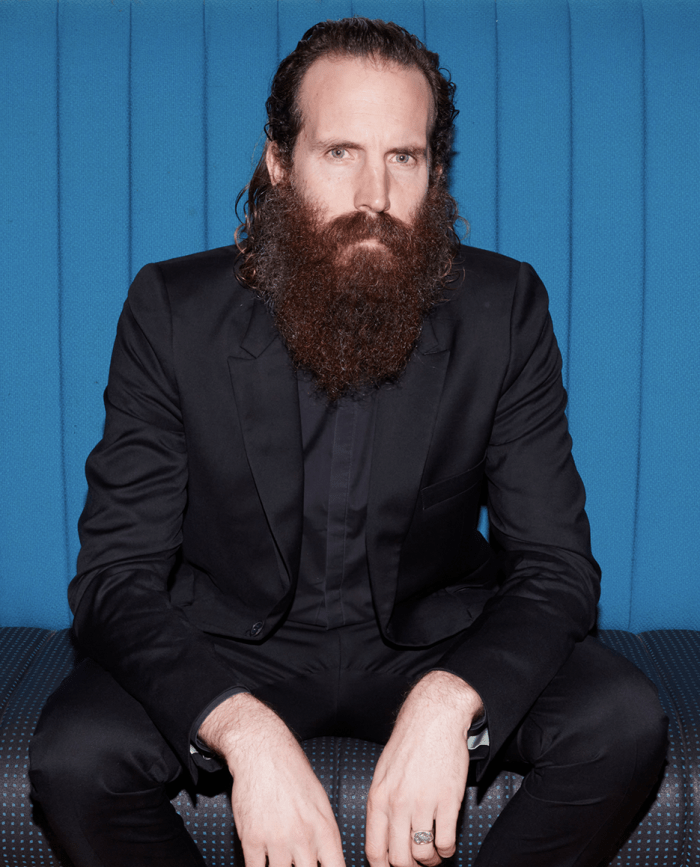
Thomas M. Wright. Photo by Zan Wemberley.
Help us continue to cover more Australian films by making a donation to Cinema Australia below.

I found it hard to sleep after watching The Stranger.
Anyone who watches the film will find there’s a lot to unpack. The whole experience kept my mind ticking over that night, and for days afterwards.
The Stranger is a grim, gut-wrenching crime drama inspired by the real life capture of Brett Peter Cowan who abducted and killed 13 year old Daniel Morcombe in 2003. There’s no violence in the film, and no victim’s names are mentioned, but viewers are made aware from the very beginning that a heinous crime has been committed.
The Joel Edgerton and Sean Harris characters anchor the film, but the sprawling narrative explores the deepest kind of psychological trauma that infects an endless amount of supporting characters as an entire police operation closes in on a pitiless killer responsible for an unimaginable act.
If The Stranger is anything, it’s a reminder that you never truly know what’s going on behind someone’s eyes.
It’s also a technical marvel. The sound design by Academy Award-winning sound designer Andy Wright plays a major part in the film, drawing the viewer in to almost become an uncredited character. Oliver Coates’ score, Sam Chiplin’s cinematography and Simon Njoo’s editing all enhance Thomas M. Wright’s powerful script and his masterful direction.
The Stranger recently premiered in Australia at the Melbourne International Film Festival – the first film in the festival’s history to screen in-competition for the $140,000 Film Prize.
“When the film finished, the credits rolled in darkness. No one made a sound. When the credits ended the lights came up and nobody moved,” Wright tells Cinema Australia.
“Everybody just sat still for about two minutes, not really talking until people began to sort of stand up and filter out. And I think that’s something that’s really important with this film. It will take you to the quiet, deep interior of yourself if you’re willing to walk that path with the film.”
During my interview with Wright, I found the actor-turned-filmmaker to be fiercely intellectual when it comes to discussing film. I also found an Australian film geek who actively consumes Australian cinema. Believe it or not, that’s rare in Australia. Wright celebrates his peers and is genuinely excited for them which made our chat even more enjoyable.
Other than his admiration for other Australian filmmakers, Wright goes deep into the making of his own film discussing everything from the Morcombe’s reaction when they were sent the original draft, Australia’s obsession with crime culture, the origins of The Stranger, working with some of Australia’s best actors like Alan Dukes, Jada Alberts and Ewen Leslie, and much, much more.

Joel Edgerton in The Stranger.
“I’ll never be able to talk about how the film was researched or prepared. I can say that people who are associated with this sort of work, and these sorts of cases, have reviewed the film and can attest to its authenticity.”
Interview by Matthew Eeles
As soon as The Stranger was announced for MIFF, Daniel Morcombe’s parents, Denise and Bruce, expressed their anger at the film claiming that it’s a money grab. They labeled it a “cruel act” on your behalf, and that the film was “terribly insensitive”. How do you respond to that?
I would refer back to the statement that we made at the time, which is, this is a fictionalised account of a police operation that has no depiction of a victim. It has no representation of that victim, no representation of their family, there is no violence in the film, all names and details have been changed. And those choices, which for me are based out of a moral perspective, were inlaid very deeply into the film from the very beginning. We reached out to the family almost three years ago. The minute we had a draft of the film, they declined to be involved and we continue to respect that decision.
Were you expecting the backlash?
No. No, no. Because we had reached out to them. I really don’t feel that I wanna add any more than that.
How does it feel as an artist to have your work judged before it’s released publicly?
I don’t think it’s a reasonable response. People need to see the film to be informed. There is not a person who has seen the film who has raised any concerns or issues with the fact that the film exists. I think the film is far more considered and far more concerted in its moral approach to its subject matter than any other Australian film dealing with this subject. The decision to portray no violence, or the victim, is in no way about optics or perception. It’s inlaid at the deepest level, at the deepest fibres of the story that we are telling. It’s a film that’s dealing with broader issues of the human capacity for violence, and the need for order, cohesion, for empathy, and to make meaning when violence threatens to render things meaningless.
Australians are obsessed with crime culture. True Crime podcasts rate through the roof, we eagerly absorb any news related to gangs and murderers. We become obsessed with serial killer trials. We worship criminals like Ned Kelly and Chopper Read, and we eat up shows like Underbelly. But it seems to me that when someone like yourself, or Justin Kurzel with Snowtown and Nitram, makes a movie about a true crime which actually examines the human psychology behind a case, there’s outrage. What’s your take on that?
Justin and I have talked at length about this with one another. We are very different artists with very, very different intentions. When you look at what those films are intending, they’re not of a piece. They’re both dealing with difficult material, but from very different perspectives. Both Snowtown and Nitram conclude with the promise of a final emphatic act of violence. The Stranger begins after the violence. That’s already, I think, a really significant difference. I think a woman a week is killed in domestic violence incidences in Australia. I think discussion about violence as a society is necessary, and continues to be necessary.
I took on this adaptation and this project with the most serious sense of moral responsibility. It was a very difficult and a really heavy weight to carry for several years. I think it’s a valuable contribution to the conversation. It’s interesting because that body of work that makes up Australian crime cinema is actually extraordinarily diverse. Australian crime cinema are very different film. There’s a continuity in Justin’s work from Snowtown to Nitram. But when you look at Ghosts of the Civil Dead to Chopper, they couldn’t be more different films about a similar subject matter. Or something like Animal Kingdom to The Boys. There’s a certain alignment there with the subject, but the films couldn’t be more different. It’s an important part of our artistic heritage and it’s important to remember that it extends well beyond cinema and into our literature, our visual arts, our music. It’s something that I said on the opening night of the film that, you know, for me, part of that at least is that this is a country that’s defined by hidden violence. A violence that we’re conscious of, but we’re unreconciled too. It’s unsurprising that it features so much in the work of artists in this country.

Joel Edgerton and Sean Harris in The Stranger.
Take us back to the early origins of The Stranger. The original idea for the film came from Joel Edgerton who had optioned the book, The Sting: The Undercover Operation that Caught Daniel Morcombe’s Killer by Kate Kyriacou. But you had reservations about adapting that into a film. Can you elaborate on that?
Joel and I were in discussion about me playing one of the parts in his film, Boy Erased. When Acute Misfortune was financed that conversation couldn’t continue. Joel being a really very generous individual said to me, “When you’re done with Acute Misfortune, send it through.” He was about the first person I sent it to when I finished the film. Before it had even premiered, Joel watched the film and called me the same day and said, “Anything you wanna do, let me know. I’ll invest as a producer if you want to co-write or if you want to direct me in something.” Very, very quickly we came to the discussion of Kate Kyriacou’s book, The Sting. I wasn’t aware of the operation or anything about it. I was certainly aware of the case and aware of that particular case in lineage of similar cases, like the William Tyrrell inquest that’s been going on for a long time, and Lindy Chamberlain, and other high profile cases. I was aware that this boy had disappeared, but I didn’t know anything about the actual case. I read Kate’s book and I thought, “I can’t do this. I can’t manage this. This is overwhelming to me.” I was really afraid of it.
Was it just the subject that you were afraid of, or was it also because the case and the story itself is so expansive?
It was the darkness. It was because I knew that I was going to have to go in and deal with this material for the next three years. I had a six year old boy at the time. My son who actually plays Joel’s son in the film was six years old at the time. When I read this my partner said to me, “I don’t want you to do this. I know where you’ll go.” But as I looked at it and looked more closer, I saw a film that though violence is the reason for the film, it’s not its subject. The subject is the connection between people and therefore the connection of a society, and it’s a film that was defined by empathy. And also by a really universal fact, which is that we all had to move from childhood into the adult world. And as you come into the adult world, you become aware of the violence and the darkness that’s in this world. We each need to find our own way to negotiate that and make our way through that reality. And here is a very distilled construction of that idea for that central character in the film, whose name we never learn. And I think that’s a significant thing that we never know his name. We don’t know who our central character is. We don’t know him by his name. That idea of the stranger, whether that’s the person responsible for this crime, or the victim, or those who care for the victim to whom these other people dedicate years of their lives and their mental and physical health. Or it could be those nameless and generally faceless people toward the end of the film who resolve it. I was interested in the fact that we are in a culture of strangers We rely on strangers so much, and that’s a really potent fact for me.
I imagine a lot of research went into so many different aspects of this film. But I’m keen to know about your research into police psychology, and especially undercover police. This is a world none of us could ever imagine. How deep did you go?
I’ll never be able to talk about how the film was researched or prepared. I can say that people who are associated with this sort of work, and these sorts of cases, have reviewed the film and can attest to its authenticity. I’m afraid I really can’t discuss it. The film had to be on one hand forensic, and on the other hand psychological, and that had to be really, really authentic. Authenticity is everything to this film, while at the same time acknowledging that it’s a fictionalised interpretation.
Have you ever had a personal interest in psychology throughout your life?
Only through this film. I mean, the thing about being a writer and director of film is that it affords you extraordinary opportunities to specialise in certain fields whilst acknowledging you are not the authority on these things. I’ve met people who work in film that because they’ve made a film on a certain subject, people then assume that they’re some sort of authority on that. I don’t feel that way at all. But the research that we did on the film was exhaustive and exacting. After I finished the first draft of this film after six months of full time research, ten hours a day six to seven days a week, I was hospitalised with pneumonia because it took such a toll on me and on my body to hold onto this material. That initial draft is the draft that was financed by the way.
How are you feeling now?
I’m alright. It’s taken a while. You can only begin to consider what it would actually be like for people who deal with this every day.
You’ve said during another interview that the film left a mark on the actors involved. I’ve read similar stories, and I’ve spoken with other actors who have found it difficult to shake some characters. Can you explain how an actor’s psychology or behaviour changes on set when they’re dealing with such heavy material.
Everybody on this film was so committed. Joel prepared for this film for about two years. I think it’s Joel’s strongest ever work on film. I watched him completely transform. I watched this part change him on a physical, psychological and molecular level. While we were in the midst of making the film, Joel found out that he was going to be a father and that made the film intensely personal for him. As I said, I cast my own son as Joel’s son in the film and those two prepared for a year together, writing to each other, telling stories, crafting a narrative between them, understanding what their family was that these two were going to create. And then we got into a house with those two characters and we improvised for four days around certain scenarios and themes. Sean Harris had over a year to prepare for this part. He lost his father in preparation for the film and found himself on the other side of the world, in the midst of a pandemic, separated from his partner. And he threw himself into this part with auto conviction. And I think the result speaks for itself with both of their work. There were moments when we were making this film where it certainly crossed over into reality. It was a very difficult film to make. But, you know, the fact that we had 65 people who worked on the film turn up for the premier of the film in Cannes speaks to the personal investment. And that’s what I asked for from each of the collaborators, whether that was assistant editors, production designers at every level of this thing. People needed to find their own personal reasons for telling this thing. And I wanted everybody who makes this film to be able to stand behind it and feel that they had a right to tell this story, and that they were talking about things that were essential to them. For me, that was embodied in my son because I felt if I’m gonna make this film with him in the role, if I’m gonna tell a story like this, if I’m gonna deal with these ideas, the counterpoint to that is the care I have for him, the dedication I have to him. He was my reason to be there.
Are you still happy to have cast him in the film?
Not one measure of regret. As I said, I feel like the choices that we made in the film were considered and very particular to this work. And I think that’s reflected in being the first Australian film In Certain Regard at Cannes in eight years and the first film to screen as part of competition in the Melbourne International Film Festival’s history. And the first film of our sort to be picked up worldwide by Netflix, because I think our partners and collaborators can see the value in this work.
We expect an actor as experienced as Edgerton to be good here, and both he and Sean Harris knock it out of the park, but I want to talk about some of the supporting actors like Jada Alberts and Al Dukes, and even Ewen Leslie who has such a small role, but he really brings the film home with his quality of acting.
I needed people that could anchor the film and work at that level. Jada is so raw, so potent. She’s such a powerful thinker and a really great writer. Building the psychological fabric of this film when you’ve got 65 speaking parts was always going to be really difficult, and that’s very fine work. That takes an awful lot of time. I felt that Al brought something particular to that part. He’s a consummate character actor. I think he’s one of the strongest actors in this country. I think he’s an actor who uneasily sits outside a lot of the archetypes that we offer up in this country. That’s the case for a lot of our great character actors. I would say the same for Steve Mouzakis, who plays Paul in the early part of the film, that if these guys were in New York, or anywhere in America, they would be recognised as defining character actors. Unfortunately in Australia, I don’t think people write enough of those parts, and the spectrum of humanity that’s represented on film can often be quite narrow. We were all blown away by Al’s work in the film, but I honestly feel the same about Jada and Steve, and Matthew Sunderland. As much as there are those two central characters, Jada really anchors half the film. And it’s a difficult thing. And often I feel like there’s not enough commentary on their work, in the film, because you don’t find out anything about Jada’s Detective Rylett, or her offsider. We only come to know these people through their work, and that was a really important idea to me again, in the idea of strangers that we have to reach out and form those connections ourselves to those characters as audience members. We’re not given pieces of information that lead us back to what their home life might be like, or their religious or personal backgrounds. We can only incur it. I like a film that makes an audience work. I don’t like to be a passive audience member. And I think that’s really clear in how much people love true crime narratives and documentaries where they’re presented with information and then asked to put it together. You never know what people are carrying. You never know what’s behind their eyes, what they’ve been through, or the extent of their empathy for others. So look closer, you know?

Sean Harris in The Stranger.
There’s an interesting moment in the film during a police interview at an RSL where you include a moment’s silence for fallen soldiers which is very common in most RSLs around Australia. Tell us about your decision to include that?
I think it’s a complex moment in the film. There’s a lot going on there. It’s an acknowledgement of the fallen. A lot of police officers also have military backgrounds. You also have an indigenous detective standing there listening to this and having to her work into a case that’s present, that’s happening in the moment. I think it’s sufficient to say that will be interpreted many ways by many different people.
Did that moment come to you in an early draft of the script? Or was it something that came later?
Most of the significant moments in the film were planned very early on. The form of the film really didn’t change a lot from the first draft to what’s in the finished film. It leaned out, but that’s inevitable with all films. The actual passage of the narrative arc was consistent throughout.
Sound is something that’s very important in the film. As an audience member I felt I had to listen to everything that was happening incase I missed something. You made me feel like I was part of the police surveillance team, which I thought was very clever. Is that a correct observation?
Absolutely. A significant part of this film is recording and collating information. Setting things up to record picture and sound. And then trying to organise them to make meaning of them, as well as the writing of a narrative. That’s all a part of it. So yeah, the audio part of the film had to take you into there. But it’s also a highly psychological film, so it moves seamlessly between forensic literal recording of evidence and a psychological perspective, and they actually become interchangeable. And that’s the chaos that the central character finds himself in the middle of. I could not be more proud of the sound design in this film. Andy Wright is an Academy Award-winning sound designer who was the sound designer on Hacksaw Ridge. We worked for a very long time, and very intensively, to try to create something that didn’t sound or feel like anything else. And hand-in-hand with that is also the score by Oliver Coates and the additional percussion score by Mathias Shakana which is that first sound that you hear when we land on the shot of that mountain. Through the film we needed to put you inside the minds of these characters. We needed to put you in their shoes, put you in the car with them and create that pressurised environment that starts to shake more and more and more as the film goes along. And it threatens to fall apart at any moment.
And there’s a particular scene of dialogue between between Mark and Henry in which you use the car surveillance sound as the film’s audio. It’s genius
There’s are two scenes where we do that in the film. One of them I think was determined beforehand and one was found in the process of making the film, but I think fairly early on, and fairly organically. Part of that idea was that there’s a cognitive dissonance that’s happening in that scene. There are multiple agendas taking place which are totally inscrutable. It’s almost like an audio representation of an anxiety attack.
You’re a terrific actor yourself, and you’ve been lucky enough to work with some of the world’s most celebrated filmmakers like Jane Campion and Warwick Thornton. Will you keep acting, or would you prefer to move into writing and directing full time?
With the right people I would act again in a second’s notice. Cinema is my life. Really. And the thing that I love about cinema is it’s different and it’s diverse. The diversity of viewpoints, of references of backgrounds, subject matters, of ways of negotiating circumstance and finding your way through the storm of making a film. We have many great filmmakers in Australia. And I actually think it’s a really interesting time for cinema in Australia. I think people like Goran Stolevski, Kitty Green, James Vaughn who’s first film Friends and Strangers came out last year. Amiel Courtin-Wilson, Justin Kurzel, Jennifer Peedom. The list just kind of goes on. And of course David Michôd and Andrew Dominic, who I’m doing an in-conversation with about his Nick cave documentaries. Andrew has become a mate and I can’t wait for everyone to see Blond. I think it’s a really thrilling time for Australian cinema in a landscape that’s been so shaken for such a long time in terms of how films reach audiences and how our government engage with film, and the idea of what it is to see ourselves reflected back to us and how important that is. It’s so important for people to engage with the cinema of their landscape and of their country and where they’re from. There’s also Rob Connolly who directed me in Balibo when I was 24 years old. It’s an interesting time, and if the right opportunity is there I’d certainly act again. But, you know, my time is wholly invested in writing and directing film at the moment.
The Stranger is currently screening at the Melbourne International Film Festival. Details here. The Stranger will be available worldwide on Netflix in October.

ADVERTISEMENT

ADVERTISEMENT


 Cinema Australia