
DOP Jesse Frazer and Josh Shipton with Helmet Rig. Photo by Matthew Syres Photography.
“Initially this was conceived as an art piece of purely stop-motion scans which proved problematic in terms of storytelling and narrative flow.”
Written by Shahane Bekarian (director):
The Blind Passenger is not your usual short film. It’s kinda fucked up.
It’s a concept film taken from the point of view of a blind man, about the struggle he faces of impending doom and/or paranoia as he adjusts to his loss of sight while trying to find stability from a new found lover. The character’s projection of the external world and his emotional response are shown through his mind’s eye; the world around him breaks down, his grounding shifts, and boundaries lose definition. Everything he used to rely on is now bereft as he clings to one thing to survive; a woman.
As filmmakers, ‘seeing’ from a blind man’s POV provided a blank canvas, it allowed for endless creative freedom. Although this seems like an artist’s dream, without any boundaries this infinite space became a curse; how far would it go and where would it stop? I needed boundaries too. I didn’t want the audience in seizures from the flashing thoughts the main character Lewi would be experiencing, as most humans do. So I toned it down and concentrated more on building an expanse around him. It became more about the world that his overly active visual cortex creates, a common phenomena in the blind. This calmer method allowed the space needed by the viewer to borrow from their own experiences and mental flashes to fill in the blanks, hopefully melding into one mind with Lewi.

Lily Brown as Summer. Photo by Matthew Syres Photography.
The idea was to give prominence to touch and sound, creating a visceral and sensorial world mimicking a blind person’s attuned senses. The perception of touch was achieved using a flat bed scanner for Lewi’s face, body and all the things he would come in contact with and therefore ‘see’. We took about 6,000 scans of which about a third were used in the final film. A directional and spatial sense of sound was achieved using a 3d binaural microphone – ideally this film should be heard through headphones to fully appreciate the effect.
Initially this was conceived as an art piece of purely stop-motion scans which proved problematic in terms of storytelling and narrative flow. Just seeing scans of Lewi and the things he touched voided a strong connection with his character. We needed real-time footage of Lewi and those around him to avoid delving into complete art-house madness. Although completely blind, his other senses are attune with his mind to fill in the gaps, forming some semblance of the world he once knew, which the audience sees on screen. Visual representation was needed to translate Lewi’s other senses to the screen, which I hope The Blind Passenger accomplishes. So with that in mind the decision was made to mix heavily treated footage with stop-motion scans, to make visible his body of senses on the screen. (Besides, the scans would’ve taken too damn long and sent the actor of Lewi, Josh Shipton blind himself; it can’t be good to stick your face against the intense light beams of the scanner thousands of times. Bless you Josh for your patience and confidence in this project. See his commitment to blinding himself here – http://youtu.be/zgbmm2in7Kw.)
It was important to have the binaural microphone matching Lewi’s POV. As Josh turned his head to listen for in-situ sounds, the directional mic had to follow. Usually this is faked by panning between the stereo pair of channels toward the sound source. Binaural microphones don’t allow that kind of control in post; you have to capture it in the microphone on set. So we had to attach the binaural mic to a helmet rig with the Canon 5D. This was by far the biggest challenge and proved to be more trouble than the results were worth. It was both a technical nightmare for the audio crew, and a huge burden on Josh’s neck from the weight, which caused him much grief, and the need for regular breaks. It also meant that sounds, which we wanted binaurally recorded, had to be rehearsed. Then in the edit suite we were often forced to use sync sound for specific takes, and we couldn’t stitch up a performance from numerous takes without losing the 3d directional effect. It became evident why this technology isn’t taking off; despite its potential it isn’t very practical.

Director Shahane Bekarian. Photo by Matthew Syres Photography.
If I had any tips to young filmmakers, it would be this: learn to adapt. There’s a common saying that when you make a film, you make 3 films: the one you write; the one you shoot; and the one you edit. As a creator, you must be willing to change and adapt to the instability of the swaying ship of filmmaking along each of these steps. Once you start shooting everything changes; parts of the script may not read well on screen after sacrificing the ideal location due to council approval not coming through because you couldn’t afford the $20 million insurance liability after your lead actress demanded her own personal fluffer, for instance. Then in the edit suite the only footage you have to work with is what was shot, again things might not translate from camera to edit. Or if something went wrong for whatever reason you have to work with it, and this often means changing the film. You need to maintain your bearings as the whirlwind takes hold of you; be willing to sacrifice and compromise while remaining open to opportunity. Luck is the residue of design. Don’t let your ego bind you to your ideas, let go of ownership of the story. Remember the story itself is the owner of the film, we are but pawns to bring it to the screen, like a captain of a ship at the mercy of the sea bringing her to shore, arrrrhh!
Seizing opportunity is how this 3-person project became a 30+-person project. As the venture evolved and the torrent stormed through we just held on for the ride. My personal highlight was working with the infamous Grant Page on our car accident stunt and seeing a 50ft cherry picker beeping down the backstreets of Marrickville causing half the neighborhood to come out for a sticky beak while I was thinking to myself “how the hell did all this happen?!”.
Needless to say the budget blew out, but since it was mostly self-funded I let the eye of the storm sway our path. Crowd funding through Pozible and a fundraising night with music (and popcorn!) also helped with the creation of this monster.
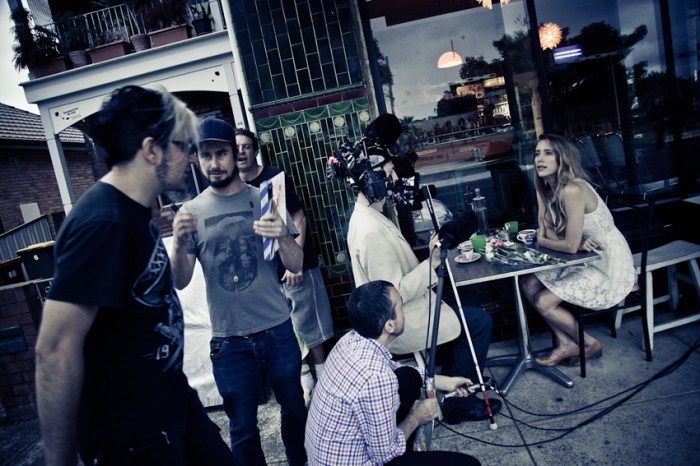
The team in action. Photo Matthew Syres Photography.
We were lucky enough to have the upcoming talent of Lily Brown from the UK perform the role of Summer. It was her innocent beauty, which contrasts so well with the darkness brewing within the blind curmudgeon Lewi – so acutely humanised by the likes of Josh Shipton. They both struck a chord with their characters because they could truly relate to, or understand their respective roles. As a first time director I learnt how invaluable this would be towards achieving a genuine performance.
The Blind Passenger is a screen experiment, and after two people walked out demanding their money back from the Sydney Underground Film Festival premiere, I knew I was onto a good thing. I’d like to thank the Revelation Film Festival who’s taking this to a larger audience, a must-do festival for any boffin. I couldn’t be more humbled having my film as the pre-screener for the Texas Chainsaw Massacre, one of my childhood favourites. It’s great to see the ‘short + feature’ format in festivals, it’s not common enough and is great for supporting local filmmakers.
More ranting here: http://www.facebook.com/TheBlindPassenger


 Cinema Australia