Welcome to the 6th edition of Cinema Australia’s Sunday Shorts feature. This weekend our profile focuses on Tropfest finalist Off The Meter staring Neighbours’ Alan Fletcher. You can watch the short below.
“Since I was also directing, I had no one saying I needed to cut it down to size, and I kept telling myself it would fit when it clearly wouldn’t.”
Staring Alan Fletcher
Written and Directed by Carl J. Sorheim
Producer Julian Constanzo
Witten by Carl J. Sorheim (writer/director):
When I brought up the idea for Off The Meter with my friends and colleagues in The Cameralla, a creative collective I co-founded about 4 years ago, it immediately hit a nerve. Initially, I wanted the main character of Daniel Folkmover to be a fourth generation people smuggler with financial gain as his main objective and we all imagined him as the David Brent of human trafficking: An awkward, egotistical and dad-jokey guy, going somewhat against the norm of a “standard evil people smuggler”.
I went away for a short work stint overseas in July 2013, and during this period I had some time to reflect on the character and his universe from the outside. It was election time in Australia, and this dominated the news. Abbott was using the same old rhetoric, “promising to stop the boats”, and Labour wasn’t far behind. Suddenly I didn’t want to be part of the choir pointing their fingers at people smugglers anymore. Not because I side with human trafficking – quite the contrary – but because we found ourselves in a ludicrous game of who could be the most hard line and the biggest bully. The conversation wasn’t about how we could stop the wound from being inflicted in the first place; it was about where we could apply the Band-Aids and how hard.

So I decided that Daniel Folkmover couldn’t be a nasty or greedy human trafficker, because this character had been outplayed by the government; he had already become a cliché, and whether or not I made him a socially awkward and comical character, it wouldn’t be adding to the conversation, it would just be another sounding board for the prevailing opinion. The more negative the spin got in printed media, the less interested I found myself in creating another negative character. I came to feel that we had enough villains, and that I didn’t want to take part in the Battle of The Blame. Instead, I wanted to create an everyday hero, and a little story of hope.
When I returned to Melbourne mid-August with the first draft, we decided to aim for a Tropfest submission. Obviously, with a deadline in October the same year we had to kick things into gear, and the script went through another three or four drafts and discussions to get it down to size. We were in early September when we were happy with it. Our producer Julian, who was working on Neighbours at the time, approached Alan Fletcher, who despite an incredibly busy schedule, said yes almost immediately. With Alan on board, we got our regular skeleton crew stars behind and in front of camera; DOPs Jaque Fisher and George Arnold, sound recordist Tom Campbell, and make-up artist Shelby Conn all took on the job with incredible vigour, flanked by the enthusiasm of Runner Joey Yap and my wife Nara. The next hard bit was the very difficult casting of our refugee characters. Asking extras to work for free is hard enough; finding extras of various ethnic backgrounds who can act and are willing to work for free – in the middle of the night – well, that’s a whole different ball game. Luckily we got a bunch of talented people who were incredibly giving, and who felt that the story was important enough to justify the inconvenience.
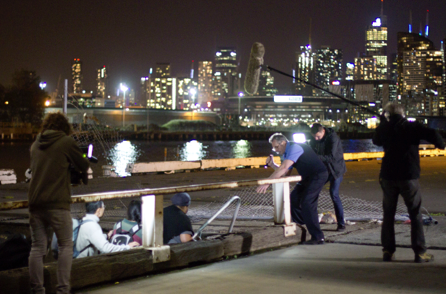
The film itself was shot over 24 hectic hours from 26th to 27th September. With a budget that came solely out of the pockets of a handful of semi-employed actors and writers, we had to keep things tight. Very tight. All the cab scenes had to be done within the same 24 hours to avoid going over time (we were already on mates rates with the owner), which isn’t that easy when you’re battling traffic and the work restrictions placed on children. One of our stars, the incredibly cute and immensely talented Tatiana was barely six years old at the time.
Post production wasn’t easy going either, with time constraints being a major obstacle: Two weeks of post-production, even for a budget mockumentary, is not enough. That said, we have entered the 48 Hour Film Festival four years in a row, making some great 7 minute flicks in only two days (one year, we even made two 7 minute films in two days), so we’re no strangers to a horrible deadline. Tropfest also happened to extend their deadline, and suddenly we had a whole extra week of post, which meant some people actually got the luxury of sleep. Another major obstacle was me. One of my issues as a writer – and I’m slowly learning this – is restraint. A script with nine pages of dialogue will not fit into a seven minute film unless you’re shooting Gilmore Girls or possibly West Wing. Since I was also directing, I had no one saying I needed to cut it down to size, and I kept telling myself it would fit when it clearly wouldn’t. With the film sitting pretty at about 8 and a half minutes, we were in a spot of trouble. Thankfully the fantastic Melanie Rowland was able to use her editing skills to wrestle the content into a slightly different shape and still make sense of it. It was hard seeing jokes go and forcing tempo on scenes I initially felt needed space to breathe, but it was a matter of either having a 7 minute Tropfest submission or an 8 minute short film for general festival submission – and we felt this was a perfect fit for Tropfest. Luckily, as it turned out, they felt the same.
I learned a tremendous amount from shooting Off The Meter, and to me, the film proves what I always say: all you need is a good story and some talented people around you. The rest is icing.


 Cinema Australia