
Nicolas Cage and Lorcan Finnegan on the set of The Surfer. Photograph by David Dare Parker.
The obvious question most people will ask about The Surfer is: “Is it an Australian film?”
It’s written by Thomas Martin and directed by Lorcan Finnegan – two Irish lads – shot by a Polish cinematographer, produced by Australian Robert Connolly, and stars American actor Nicolas Cage in the lead role.
While the film is officially an Irish/Australian co-production with a universal subtext woven through its acid trip-like narrative, The Surfer is soaked in Australiana. From our classic jolting phrases like “yeah, nah,” to our territorial surf culture, deadly fauna, and an unparalleled Western Australian beachside setting, everything about The Surfer feels as Australian as crackin’ a tinnie at the beach.
As Cage’s descent into sun-drenched madness unfolds in The Surfer, viewers may also notice the influence of Australian New Wave cinema, such as Nicolas Roeg’s Walkabout and Ted Kotcheff’s Wake in Fright—two iconic Australian films directed by international filmmakers.
So for argument’s sake, let’s just say yes, The Surfer is an Australian film.
In the following interview, The Surfer director Lorcan Finnegan talks us through some of the other films that influenced both the narrative and style of The Surfer, his experience working with Western Australian cast and crew, and his relationship with the one and only Nicolas Cage.
While The Surfer explores clear themes of masculinity and materialism for those who enjoy films with deeper meaning, this nightmarish thriller is also one of the most fun and wild rides you’ll have with a movie this year.
The Surfer is in cinemas from May 15 before it lands on Stan. June 15.

Director Lorcan Finnegan with Nicolas Cage on the set of The Surfer. Photograph by David Dare Parker.
“Nic was familiar with a lot of the New Wave Australian films we were influenced by, and he was excited to do it.”
Interview by Matthew Eeles
You were born in Dublin. Do you have a memory of when you were first introduced to Australian culture?
Funnily enough, it was my primary school teacher, who had lived in Australia for a long time before she moved to Ireland and became a teacher. She brought back all of this stuff—which probably seems quite cliché now—but she had a boomerang, a didgeridoo, and all these amazing photographs. She taught us a lot about Indigenous culture, but I would have been very young. Everybody of my generation in Ireland grew up on a diet of Home and Away, Neighbours, and also Skippy. I visited Australia for the first time in my twenties for a friend’s wedding. We hung out and had a good time. I’ve worked in Australia shooting TV commercials, and I’ve been back and forth with film festivals. So, I’ve been to Australia a lot, but there’s still a lot to explore. I haven’t been to the Northern Territory, and I haven’t been to Adelaide. I want to go back and see more.
I get a lot of excitement out of hearing about a non-Australian having an interest in Australian New Wave cinema, because the unfortunate truth is that a lot of Australians don’t actually know that that era existed. What was the first Australian New Wave film that caught your attention?
I studied graphic design originally, and I got into filmmaking a bit later. I got into motion graphics, then animation, and then started doing live-action filmmaking. So it was after college that I really started getting into filmmaking, which also coincided with me watching a lot of cinema from around the world. I was really drawn to the Australian New Wave—Peter Weir’s early films like Picnic at Hanging Rock, The Last Wave, The Plumber, and Colin Eggleston’s Long Weekend, which were all influences on my first film. I made a film called Without Name, which is a sort of supernatural eco-horror, like Long Weekend is. A little bit later, films like Walkabout and Wake in Fright, and the more mainstream Australian New Wave films became influences for me. That tradition of filmmakers like Nicolas Roeg—who’s British—and Ted Kotcheff—who’s Canadian—heading to Australia to make films is an interesting one. So when Thomas Martin, the writer, sent me an outline for The Surfer back in 2019, we both loved that period of cinema and started talking about how there hasn’t really been anything like that in a long time. Films like the ones we loved—there was an explosion of them in their era. They were great, and they were so interesting and unusual and experimental in a way. They had great performances and were small films, but almost hidden gems. But films like those stay with you forever. We wanted to make one of those films, and we both said, “Let’s try and make it in Australia.”

Director Lorcan Finnegan with Nicolas Cage on the set of The Surfer. Photograph by David Dare Parker.
You can certainly see the influence that those films had on The Surfer. How exciting was it for you as a filmmaker to incorporate some of that influence into this film?
It was very exciting. And those films have not just influenced The Surfer, but my entire filmmaking career in general. They’ve influenced my editing, use of colour, cinematography, sound design, music. They were very influential. In the seventies, there were these really fascinating films coming out. It was exciting cinema. As well as the Australian New Wave influence, there was also Hiroshi Teshigahara’s Woman in the Dunes. That was an influence on this as well. And Frank Perry’s film The Swimmer was definitely an influence, not only on the film but the writing as well. I think John Cheever’s short story The Swimmer was an influence on Thomas Martin. Robert Drewe, the Australian writer who wrote a collection of short stories called The Bodysurfers, also influenced Thomas quite a bit. A lot of Polish cinema influenced The Surfer as well, like Polanski’s The Tenant and Cul-de-sac. The cinematographer I’ve worked with on my last two films, Radek Ladczuk, is Polish and studied at the same school Polanski went to.
You’ve known Thomas Martin for quite a few years now, and you’ve said that you’ve wanted to collaborate on something together for a while. What was it about this particular story that made you go, “That’s the one”?
We met at the Tribeca Film Festival in 2012. We both had short films there, and we got on well. It turned out we actually lived about 50 metres from each other at home, and we started hanging out every now and again when we had time. We planned on doing something together. We just didn’t think it would take this long. [Laughs]. And when he sent me a couple of pages for The Surfer, I think what interested me was trying to make a film that was from the subjective point of view of a single character completely. We never cut away to another scene to learn information. We never look at any objective truth of what’s happening—it’s all from this character’s point of view. And as he becomes dehydrated and delirious, he becomes an unreliable narrator. So there’s that, plus the fact that he’s this guy who’s at a certain point in his life where he’s amassed some wealth and a career, and he seems to have everything together, but really everything’s falling apart—and he can’t see that. He’s just focusing all his energy on buying this house he grew up in as a child, thinking that’s going to fix all of his problems. He has a materialistic goal. And then across a few days, he’s stripped of everything—all his worldly possessions and his ego. He goes on this journey where he has to lose everything in order to find what it is he really needs, which is quite simply to go surfing with his son. That was an attractive proposition to me. And a challenge as well. It’s quite difficult to make a film that’s set in just one place, with just one character, really. To make that work as a movie and bring the audience on that journey—and make them feel like they’re Cage’s character going through all of that—that was exciting.

Director Lorcan Finnegan with Julian McMahon, Finn Little and Alex Bertrand on the set of The Surfer. Photograph by David Dare Parker.
Had you been to Western Australia before making The Surfer?
I stopped off in Perth on a flight once, but I didn’t get off the plane. So when we started talking to Arena Media about shooting The Surfer in Australia, it was very quickly settled that it would be Western Australia. We discussed shooting on the East Coast or the Gold Coast, but James Grandison, one of the producers, lives in Perth and just knew we should be looking at WA. Western Australia is not a little space—it’s gigantic, like a third of Australia. I came over on a flight and we scouted locations. We went from Perth as far north as Kalbarri, then back to Perth, and then down as far as Yallingup—which was actually the last place we checked out, and it was just perfect. [Laughs]. Once we arrived there, the water had that beautiful turquoise crystalline quality. It’s quite evocative of memory and dreams. The beach has beautiful golden sands, and then there’s that car park perched above the beach with great vantage points, and it’s all national park behind it. It’s weird when you find a location that speaks to you. We were really just dropping characters into that place to populate this story’s world. This location makes up more of this film than the actors do.
Speaking of actors, I’m very proud of the world-class acting talent we have here in Australia. The local cast you’ve assembled really held their own opposite Cage. How impressed were you with the local talent?
I was blessed—not only with the actors, but the crew, all the heads of departments—everyone was amazing. And actually, a lot of the actors were from Perth or WA. Some flew in from Sydney or Melbourne. But in general, everyone was great. Even the local people in Yallingup were brilliant and very supportive. A lot of them are in the film as well. In the scene where Cage is about to bite into a rat and there’s a man walking his little fluffy white dog—when they see Cage and the dog yelps—that’s Neil, who owns Caves House Hotel. So a lot of the locals are in the film as extras or playing smaller parts. But yeah, I mean the likes of Justin Rosniak, Nicholas Cassim, Miranda Tapsell, and all the supporting cast were excellent.

Director of Photography Radek Ladczuk, Director Lorcan Finnegan and Nicolas Cage on the set of The Surfer. Photograph by David Dare Parker.
How important was Nic Cage to this film? Did you have a backup if Cage wasn’t available?
Well, we were just going to take it one step at a time, really. We sent the script to him, and because he liked it, he read it pretty quickly and wanted to get on a call with me. So we got on a call. He’d seen Vivarium, a film I made a few years before, and he liked it, so I think that helped. He read the script and loved the writing. He thought it was Kafkaesque and interesting and challenging. We got on very well—we were into the same kind of films. He was familiar with a lot of the New Wave Australian films we were influenced by, and he was excited to do it. So we didn’t have to try anybody else. We were very lucky.
Does an actor of Cage’s calibre take much wrangling on set? How good is he at sticking to the script?
Well, a lot of the conversations with Nic about how we were going to make this film happened months in advance of shooting. So we made a few small tweaks for him in the script regarding ways that he’d like to deliver dialogue and things like that. But then, once we were on set, he never needed to look at a script again. He’s completely prepared. He knows it backwards. So actually, working with him is a pleasure because we were able to work fast. He’s got a lot of energy, and I like to shoot quickly as well. We only had 25 days to shoot the main stuff, and two days of water work. So no, he doesn’t need much wrangling. With actors, it’s more of a trust thing. You develop a relationship over the period of time before you shoot. And an actor like Nic just trusts that I’m going to use the best material and put it together in a way that’s going to be good. So he relies on you as well to make sure that you’re getting what you need for the edit, really. And then he is also tracking his character’s journey—so he knew when his voice was going to change at a certain time in the film to be more raspy, and when his limp would taper off because he didn’t want to be limping the entire time after stepping in glass. And then there was room for some playing, like creating the classic “eat the rat” line. That came from his strange connection with that prop rat when we were shooting the film. He picks the rat up and he’s about to take a bite out of it, but then he put it in his pocket—which wasn’t in the script. That was something he felt his character would do, but he wasn’t entirely sure why yet. So I think it was the next day he told me he was formulating this idea that was related to the Billy Wilder movie Sabrina, with Humphrey Bogart and Audrey Hepburn, where Bogart takes an olive and shoves it into this guy’s mouth and says, “Eat it.” Nic wanted to have an ode to Billy Wilder in there. And so he thought he’d take the rat and shove it into Pitbull’s mouth and say, “Eat the rat.” [Laughs]. So he told me about that, and I said, “Yeah, why not? Let’s give it a go and see if it works.” It worked. [Laughs].
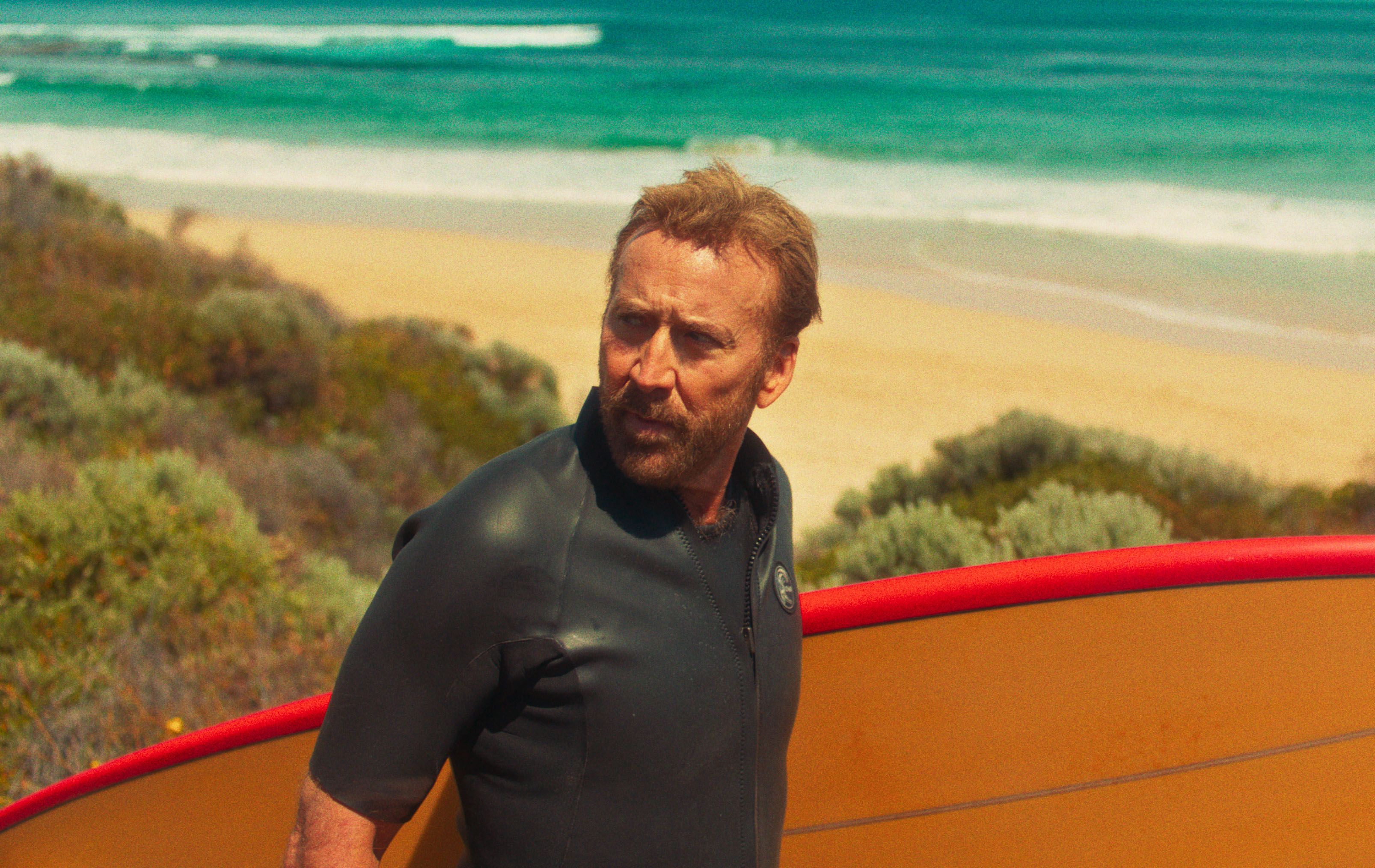
Nicolas Cage in The Surfer.
Where’s the prop rat now?
It actually went missing. It was sent back to the studio that made it, and it vanished in the post. So yeah, pretty weird.
Oh, what a bummer.
Somebody has it somewhere in the world.
Editor’s note: Spoilers ahead.
I’d love for you to talk us through the technical aspects of shooting a certain scene in the film. It’s the scene where Cage’s character is in his car on the phone to his wife, and the sun is setting before him. It’s an interesting one to me which seemed a lot more technical that it appears on screen.
Well, we had incredible sunsets, obviously, as well as an uninterrupted view of the ocean. So you get quite a long period of twilight or golden hour. But with that scene, we faked the sun on his face. I wanted there to be a feeling—as his wife is telling him she’s looking for a divorce, she’s met someone new, and she’s pregnant with this man’s child—for the light to literally drain out on Nic’s face. So we panned a lamp down across the whole scene as it took place, starting with the sun illuminating his face—it’s nice and golden and warm as he answers the phone—and then, as he gets all this information, it slowly goes down. All the light and colour drains from his face, and he’s just left in the shadow of the surfboard. For the reverse angle of that shot, we shot a plate of the sunset, which we were able to comp in around him.
The Surfer is in cinemas from May 15 before landing on Stan June 15.
 ADVERTISEMENT
If you enjoy Cinema Australia as much as I love publishing it, please consider supporting Cinema Australia’s commitment to the Australian screen industry via a donation below.
I strive to shine a light on Australian movies, giving voice to emerging talent and established artists.
This important work is made possible through the support of Cinema Australia readers.
Without corporate interests or paywalls, Cinema Australia is committed to remaining free to read, watch and listen to, always.
If you can, please consider making a contribution. It takes less than a minute, and your support will make a significant impact in sustaining Cinema Australia as the much-loved publication that it is.
Thank you.
Matthew Eeles
Founder and Editor.Make a donation here.


 Cinema Australia