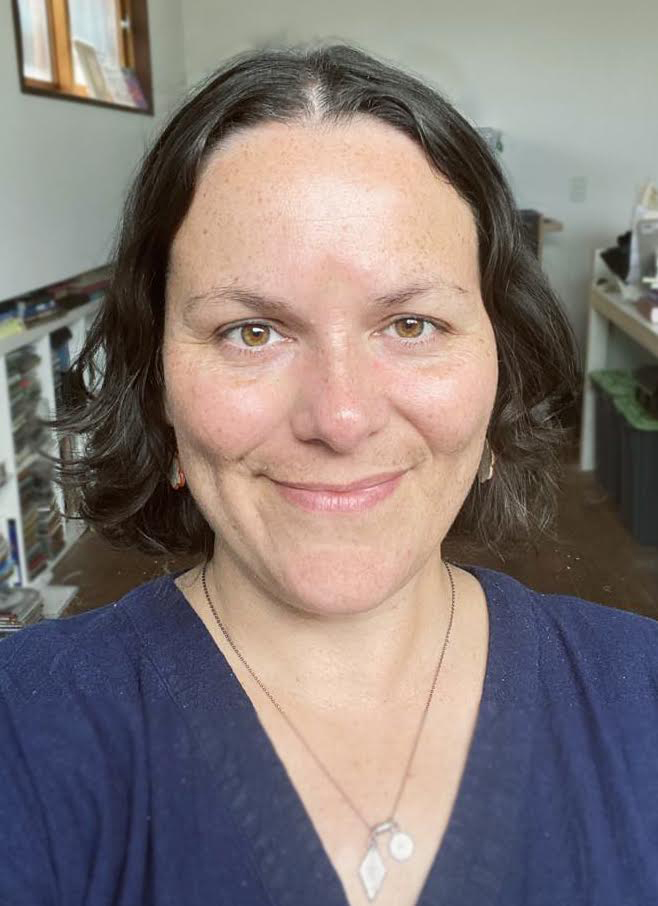
Jessie Scott.


Jessie Scott is a practising video artist, writer, programmer and producer who works across the spectrum of screen culture in Melbourne. A founding member of audiovisual art collective Tape Projects, Jessie’s latest film, Rainbow Video, is set to screen at the Melbourne Documentary Film Festival this weekend.
Inspired by Tom Roston’s oral history I Lost It At The Video Store, this playful feature length documentary uses a deep local focus to show how VHS changed art forever. As the video shop era fades to black, Rainbow Video delves into the eclectic personal collections and practices of some of Melbourne’s most renowned contemporary media artists. Through lively interviews and site studies of many legendary, now defunct video shops, Rainbow Video uncovers a secret history of a brief but impactful era.
For those of us who grew up in the 80s – we were the video generation. Born into the video shop era, our youths passed along with it. And although it was a mass pop-cultural phenomenon, artists, filmmakers and weirdos of all stripes also flocked to these places on a Friday night, and worked in them (or wished they did).
Artists and programmers such as Philip Brophy, Ian Haig, Cassandra Tytler, Xanthe Dobbie, Jean Lizza, Diego Ramirez and Spiro Economopoulos delve into their own libraries, and back catalogues, to talk about how they used video shops: as a direct source of material, as an informal, accessible art school, and as a social space to trade in cultural capital. Against a backdrop of 30 years of constantly shifting technology, Rainbow Video explores a twin history of indie video shops and libraries in Melbourne, and the underground artists that used them, proving video shops weren’t just a plot point on the historical chart of film distribution, but a crucial period of transition, whose impacts live on.
“I’ve found it really fascinating how video shops worked economically and how money was distributed to these small businesses rather than being controlled by big corporations.”
Interview by Matthew Eeles
You’re a video artist. When did you decide to make the leap into documentary filmmaking?
I think I’ve always had an interest in documentary filmmaking, and I believe I have the documentary instincts. Throughout my photography and video work, I’ve been documenting real-life things. For example, I’ve done projects about vernacular architecture in the suburbs, which involved capturing video and photography of houses and suburban streets. I believe my work has always had documentary components in it. However, with this project, since a significant portion of it was based on interviewing people and collecting oral history, I thought I could put it into a gallery and create a three-channel installation or something similar. But that would have been more challenging, and I felt it would be more satisfying to construct a narrative out of it. It became a challenge for myself, both technically and intellectually, to create something that I consider to be more demanding. It required making crucial choices about what to include and what not to, as well as how to present it as a complete work.
When and how did the final concept for Rainbow Video come about?
Well, it came about as part of a PhD project that I’ve been working on for the last five years. So the PhD project is a broader endeavor that also encompasses different artistic outcomes, such as a game, a video lending library, and this film. But even before it became a PhD project, it was already an artwork. I started noticing the closure of video shops, which I had recently rediscovered and began revisiting around 2013 or 2014. It felt like the end of the video shop era, and I thought it would be great to document some of those spaces. My instincts were simply to document as much as I could and interview some people. As I contemplated the influence of video shops on me as an artist and their role as access points for culture in every suburb and town, I wondered if other artists and filmmakers had similar experiences. That’s where the whole impetus for the project originated.
You managed to assemble quite a broad range of people to be involved in the film. How did you go about finding the interview subjects featured in the film?
Initially, I tried to document a specific and local community of artists and video shops. So, many of my initial contacts were people I knew, such as fellow artists, lecturers, and individuals I admired or was interested in. Naturally, the scope expanded as people started sharing information about the video shops they frequented or worked in. I then began speaking with video shop owners, and the project continued to grow organically. At some point, I had to assess everything I had done and identify any gaps. To some extent, it was an enjoyable process of following my instincts. [Laughs]. I interviewed many more people than what ended up in the film, including individuals from overseas. It was a delightful process, but in the end, I had to select the ones that would fit within the structure and narrative.
While I was watching the film, I was completely engaged with these subjects. In some cases, I wanted to reach through the screen and say, “Stop, I need to ask you something.” I’m curious to know more about the people you’ve interviewed for Rainbow Video. Do you think they have more of an obsession with movies in general or with VHS?
That’s an interesting question, but I don’t think I could provide a definitive answer because their interests are so diverse. I believe VHS was an incredibly versatile medium that allowed people to do things they couldn’t do before. It was particularly exciting for artists because it enabled them to copy and paste elements from movies. With video artists, it’s not necessarily about making movies or a love for film. Instead, it often revolves around finding the bizarre, unsettling, or intriguing aspects of films and incorporating them into their own work. They don’t always seek to recreate the film itself, but rather they want something about it to resonate with them, and then they utilise that as material in their own creations. VHS provided them with that capability for the first time.
ADVERTISEMENT Road to Perth is available to watch now.
What direct impact did the humble video store have on you as a filmmaker?
I think it’s the access. So many things accumulated in video stores that don’t necessarily accumulate in streaming services. I would go into my local video store, and there would usually be some kind of film nerd working at the counter who was jumping out of their skin to talk to anyone who’d listen about films they were really interested in. But also, I would be looking in one section, and next to it, I might be looking in the comedy section, and next to that is the auteur section or the documentary section. There’s just all this weird mix of stuff in video shops. Even just that aesthetic of eclecticism is something that has really influenced and affected me throughout my life. That idea of this mashup of high and low, and even all these weird and random exercise videos would end up in video shops, or dirt bike movies, and all this other fascinating stuff would accumulate in those spaces.
How much do you miss the video store?
I miss it a lot. [Laughs]. I really, really do. I don’t know that I could be retrained to give up the convenience, but I certainly miss the sense of community of being on the hunt for gems and for interesting, weird stuff. I miss the aficionados and the enthusiasts who used to work in those spaces. People forget that culture is not just about the most efficient way of delivering it. Those shops were always staffed by, if not owned by, people who had a real passion for what they were doing.
When I was younger, I worked at a video store with my mum, and it was such a beautiful experience. I look back on those memories so fondly. I loved walking up the aisles of the video store, discovering new movies. Sometimes I would just walk the aisles for hours, reading the backs of VHS covers, including the credits. I loved doing that. It’s a feeling that will never be replaced by streaming services. I’m wondering if you have a favorite memory of being in a video store?
I have lots of memories from childhood that I think are common to all kinds of people, whether they’re artists or not. But for me, it was Network Video in Brunswick West. At the time, that video shop had fallen into a doldrum and wasn’t very good. Then Network Video took over a couple of years later, and my partner and I started going there again. We had a membership, and it transferred, so we started going again. And it was just magical. It was like going back in time. We’d started downloading things online because streaming hadn’t come in yet, but we’d moved away from the video shop. Rediscovering this particular store was incredible. We used to go every week, and I’d get piles of sci-fi. I got really into Star Trek during that period. [Laughs]. The people there were always incredibly friendly. I know that some video shops were a bit snobby, but these people were just incredibly knowledgeable and passionate, but also non-judgmental. They were happy to talk to anyone about anything. And then one day, they announced out of the blue that they were closing. And that was actually what spurred this whole project because I went into a spiral of being aware of my own mortality or something. [Laughs].

ADVERTISEMENT Donate to the Old Mate crowdfunding campaign today!
Did you learn anything unexpected throughout this experience?
Oh, so many things. I learned a lot about the economic model of video shops. And I’ve been thinking about that a lot, actually, in terms of things like the actors’ and writers’ strike happening in Hollywood, which is all based around the new economic model of film distribution that concentrates all the wealth at the top rather than at the bottom. I’ve found it really fascinating how video shops worked economically and how money was distributed to these small businesses rather than being controlled by big corporations. It allowed each video shop to have its own specific personality and its own specialisations to respond to each community it was serving. And yet, at the same time, they were so efficient in terms of making films available in a way that I think algorithms and streaming networks claim to have, but they’re just such a broad spectrum. They aren’t actually able to respond to what each group of people might want to see or be interested in.
I abandoned my DVD and VHS collection when my children were born because I no longer had the space to store them all. Almost ten years later, it’s probably one of my biggest regrets, especially considering how much some of them are now selling for on sites like eBay. What’s the current state of your own VHS and DVD collection?
I think it will not surprise you at all to know that I have quite a large DVD and VHS collection. I don’t have an entire room dedicated to them or anything, but I do hold onto these things, and I do let my kids, who are very young, play with them and explore them. Recently, my nine-year-old said to me, “It’s good when you get DVDs out because you just choose a set number for us to pick from. And then it just takes away all the stress of choosing.” [Laughs]. She was really commenting on this and appreciating my curation. I’ll just pull out three or four DVDs, and then I’ll say, “Which one do you want to watch? This is the choice, go for it.” It was just really funny that she was reflecting back and really appreciating it. I had to hold onto them, but at the same time, when this whole project is over, I’m really looking forward to doing a bit of a cull. [Laughs]. I’m going to organise my DVDs and videos like a video shop. That’s my plan. [Laughs].
Rainbow Video will screen at the Melbourne Documentary Film Festival on Saturday, 22 July. Details here.

ADVERTISEMENT


 Cinema Australia